
You might be surprised to learn that most kittens learn to use a litter tray within a few days, and many seem to know how even before birth; the instinct to dig and bury is innate.
In the UK, kittens brought to new homes at eight weeks of age or older have already spent several weeks imitating their mothers. Your role is not so much to teach them, but rather to remove any obstacles standing between their natural instincts and the litter tray.
Here’s the setup, the method, a day-by-day plan, and the fixes for when a small cat improvises.
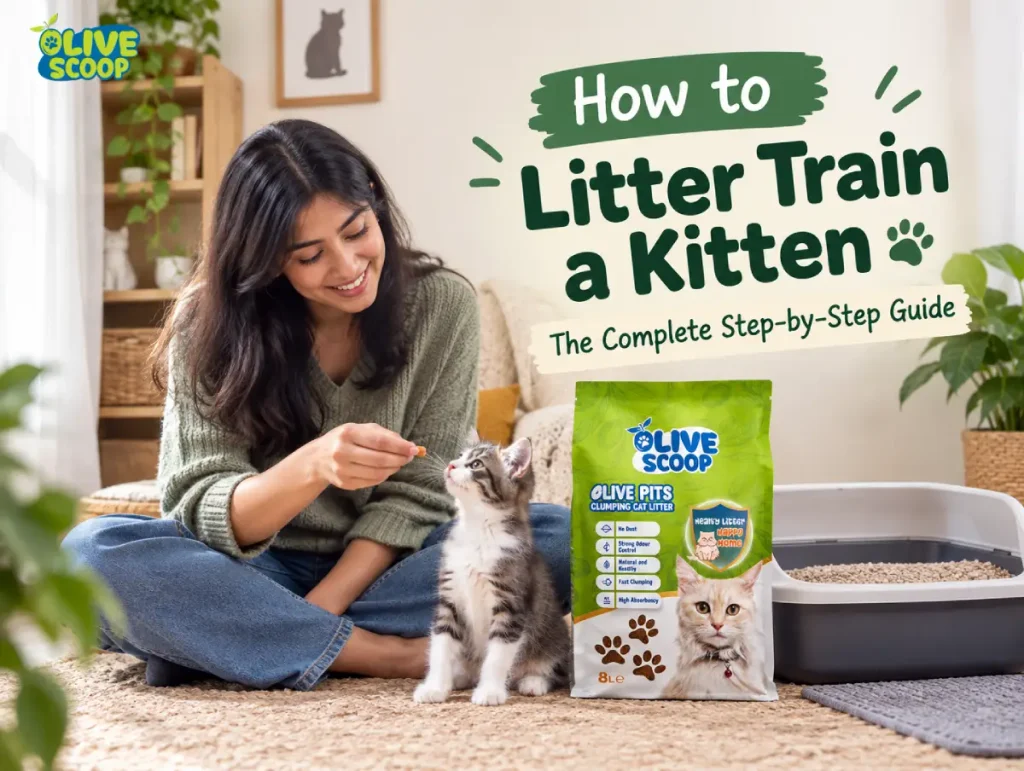
The tray. Kitten-sized and low-sided. A full-size adult tray with tall walls is a climbing wall to an eight-week-old; something around 30 by 20 cm with an entry lip their little legs can step over is right for the first weeks, upgraded as they grow. Skip hoods and flaps for now; open trays let them see, enter and exit without negotiation.
How many. Two trays minimum, even for one kitten, following the n+1 rule, and here reachability beats spacing: kittens have small bladders and very short notice periods, so no tray should be more than a quick dash from wherever they spend time.
The litter. Safety first, texture second. Very young kittens explore the world with their mouths, so start with a kitten-appropriate litter and hold off on clumping types until the mouthing phase passes.
Choose a kitten-appropriate litter, follow the manufacturer’s instructions, consider the kitten’s behaviour and always seek veterinary advice where there is uncertainty.
Whatever you choose, make it fine-textured and unscented, because tiny paws and sensitive noses reject sharp pellets and perfume alike. Fill to a shallow 3 to 5 cm so digging is easy.
The location. Quiet, visible, escapable, and away from food and water. The full logic is in our litter tray placement guide, but for a new kitten the golden rule is proximity: start the trays inside their settling-in room, close to but not beside the sleeping and eating spots.
If they came with habits. Ask the breeder or rescue what litter the kitten was using and start with the same type. Familiar texture under the paws is the strongest “this is the toilet” signal there is.
Understanding the machinery makes every step above make sense. Kittens inherit a hard-wired drive to eliminate on loose, diggable material and bury the evidence, behaviour their wild ancestors used to avoid advertising themselves to predators and rivals.
Between roughly four and eight weeks, they also imprint on substrate: the texture under their paws when the habit forms becomes their definition of “toilet” for years afterwards. That’s why fine, sandy, soft litter succeeds where chunky pellets struggle, why matching the breeder’s litter smooths arrival week, and why texture changes ever after deserve a gradual transition.
The same period wires in their standards. Kittens raised with clean trays expect clean trays; the fastidiousness owners complain about later is partly one you installed, and it’s a feature. A cat with high tray standards is a cat who reliably uses trays. Your three levers throughout training are therefore exactly three: texture (fine and soft), smell (as close to none as possible), and cleanliness (relentless). Everything else is logistics.
Kittens under about three weeks can’t toilet independently at all; their mother stimulates them. From around four weeks, as weaning begins, they start experimenting with litter and copying her. So breeders begin tray habits early, and by the time a kitten legally and sensibly comes home in the UK, at eight to nine weeks or later from good breeders and rescues, the foundations are usually laid.
Translation: you’re rarely starting from zero. You’re transferring an existing habit into a strange new building.
Days 1 and 2: kitten lives in the settling room. Tray placements after every meal and nap. Expect wobbles.
Days 3 and 4: most kittens are now taking themselves. Keep the post-meal placements going and start normal scooping.
Days 5 to 7: open up the next room or two, second tray positioned along the new frontier. Praise the first self-service visit in new territory.
Beyond: expand room by room. A fully roaming kitten with reliable habits usually takes one to two weeks; slower is normal, especially for shy kittens, and says nothing about their intelligence.
Misses right beside the tray: usually a sign the sides are too high, the tray is too small, or they left it a second too late. Lower the entry, add a tray, and tighten the post-meal routine.
Playing or napping in the tray: completely normal kitten behaviour and it fades. Add more appealing play and sleep spots elsewhere rather than policing the tray.
Eating litter: common in the mouthing phase, and the reason kitten-safe litter matters. Distract, remove what’s in the mouth, and mention it to your vet if it’s persistent rather than experimental.
Regression after progress: almost always traceable to a change: a moved tray, a new litter, a dirty tray, a fright, or too much territory too soon. Rewind one step, shrink the world slightly, and rebuild. The classic litter box mistakes list is worth a scan when regression appears from nowhere.
Accidents in one repeat spot: clean with an enzyme cleaner, block casual access to the spot for a week, and consider placing a tray there temporarily; sometimes the kitten is telling you where a tray is actually needed.
The method above assumes a human on placement duty, and real life disagrees for eight hours at a stretch. The solution is the same for overnight and the working day: shrink the world while you’re away. A kitten confined to their settling room, or later to a couple of rooms, with a tray always in sight, will keep their habit intact without supervision far more reliably than a kitten with a whole house to get lost in and a tray two rooms behind them.
Overnight, that means the sleeping room has its own tray, full stop; a kitten will not hold on until morning, and shouldn’t be asked to. During workdays in the early weeks, set up the confined zone with tray, water, bed and toys, do a placement before you leave and one when you return, and widen the zone only as the accident-free days accumulate. Cameras are optional; the tray keeps its own attendance record.
Hand-reared kittens, very early separations and some farm or feral-born kittens miss the copying stage entirely, and a small number arrive treating litter as a novelty substance rather than a toilet. The method holds, with three amplifications.
First, more placements: after meals, naps, play, and roughly every couple of waking hours besides.
Second, make the litter read as ground: a fine, soft, soil-like texture is far easier for an unlearned kitten to recognise than pellets, and for stubborn cases a spoonful of clean garden soil mixed into the top layer for a few days translates the concept, then gets phased out.
Third, keep the world tiny for longer: one room until the habit is solid, however many days that takes. Progress is slower from zero, but the destination is identical, and adult cats learn the same way if you ever take on a cat with no tray history at all.
Lucky you, and the rules barely change: trays equal kittens plus one, placements after shared meals, and expect them to learn partly from each other. Don’t force them to share a single tray even if they happily do everything else together.
Even if you plan to let your kitten outside eventually, litter-train them indoors first.
Keep kittens indoors until they have completed their initial vaccinations and your vet confirms that it is safe for them to go outside. Your vet can also advise you about neutering, microchipping and other precautions before outdoor access.
Keeping an indoor litter tray available is useful even for cats that normally go outside. Your cat may need to stay indoors because of illness, recovery, bad weather or other circumstances, so having a familiar tray gives them a safe option.
We’ve covered how long a cat can go without a litter box and the answer favours preparation. One maintained indoor tray, occasionally used, is cheap insurance against every disrupted week in your cat’s future.
Litter training should not be used to explain away a sudden change in toileting behaviour.
Speak to your vet if a kitten that was using the tray reliably suddenly starts having accidents, repeatedly strains in the tray, cries while toileting, passes very small amounts of urine, has diarrhoea, seems unwell or repeatedly eats litter.
Young kittens can become unwell quickly, so if you are concerned about your kitten’s health, contact your vet rather than relying on training alone.
How long does it take to litter train a kitten?
Days, in most cases. Kittens with a good start from their mother often need no training at all beyond being shown the tray; a fully reliable, whole-house habit typically settles within one to two weeks of coming home.
Can you litter train a kitten without its mother?
Yes. Hand-reared and early-separated kittens miss the copying stage, so you provide it: the same method above, more placements, more patience, shallow litter, and generous early rewards. It takes longer, not forever.
When can a kitten go outside?
Keep kittens indoors until they have completed their initial vaccinations and your vet confirms that it is safe for them to go outside. Your vet can also advise when your kitten is ready based on their vaccination status, health, neutering and microchipping.
What age can kittens use clumping litter?
There isn’t one universal age when every kitten should switch to clumping litter. Check the litter manufacturer’s usage instructions, consider whether your kitten still tries to eat or play with litter, and speak to your vet if you’re unsure.
For young kittens, choose a litter that is specifically suitable for their age. If your kitten is still eating litter, a kitten-safe non-clumping option may be a more appropriate choice until the behaviour has settled.
Should I move my kitten’s tray at night?
No, but do make sure one tray is reachable from wherever they sleep. If they sleep shut in one room overnight, a tray in that room is non-negotiable.
Setting up for a new arrival? Our new kitten checklist covers everything else, and when your kitten graduates to clumping litter, OliveScoop’s soft, dust-free granules make a gentle first grown-up litter.