
Somewhere quiet, with clear sightlines and an easy exit, well away from food, water and noisy machines. That’s the formula, and it rules out several of the places British homes default to. Get the location right and most tray problems never start; get it wrong and even a spotless tray gets snubbed.
Here’s how to judge any spot in the house, then a room-by-room ranking.
Cats want privacy without isolation. A calm corner of a lived-in room usually beats a distant cupboard they have to commit to a journey for.
Toileting is a vulnerable moment, and cats instinctively want to see the room and know they can leave in more than one direction. A tray jammed in a dead-end alcove can make a nervous cat feel ambushable, especially in multi-cat homes.
Cats keep toilet and dining areas strictly separate, and a tray next to the food bowl commonly results in one or the other being boycotted.
Washing machines, tumble dryers, boilers and dishwashers all lurch into loud cycles without warning. One spin cycle at the wrong moment can put a cat off a location for good.
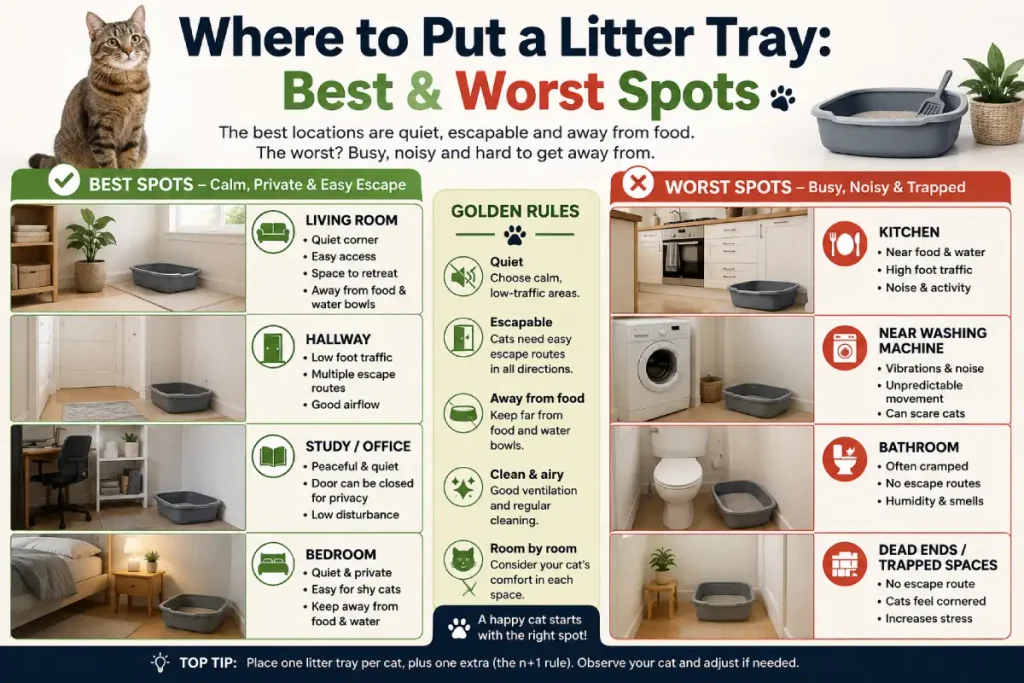
Good: the bathroom. Quiet, tiled, easy to clean around, and humans already understand its function. Just keep the door propped or fit a cat flap in it, because a shut door cancels the whole arrangement.
Good: a hallway or landing corner. Central enough to reach quickly, calm most of the day, and naturally offers exits in two directions. Landings are the standout choice in two-storey homes.
Good: a quiet corner of the living room. Better than most people expect, particularly for nervous cats who won’t travel far from the household’s centre of gravity. Position it against a wall with the entrance facing outward and the room stays comfortable for everyone, provided the tray is scooped daily.
Workable: a spare room or study. Fine, so long as the door genuinely stays open around the clock and the room doesn’t double as a store for clattering things.
Workable: the bedroom. Not the dream, but a legitimate option in small flats. Choose the far corner from the bed, keep it immaculate, and expect to hear 3am excavation work.
Bad: the kitchen. Food preparation and litter don’t belong in the same room, for hygiene and for your cat’s own food-toilet separation instincts.
Bad: the utility room. The single most common mistake in British homes. On paper it’s perfect, tucked away with a washable floor; in practice it’s a metal box of sudden noises sitting beside the tray.
Bad: conservatories and porches. Temperature extremes in both directions, and often the noisiest rain in the house.
Bad: anywhere behind a door that gets closed. The best location in the world fails the moment access does. This one causes more accidents than any litter ever has; it tops our list of classic litter box mistakes.
The n+1 rule means most homes are placing at least two trays, and the placement rule is simple: genuinely different locations, ideally different rooms or floors, never side by side.
Two trays touching read as one toileting area to a cat, so you gain nothing. In a two-storey home, one downstairs and one on the landing covers day, night and creaky senior joints.
Never teleport an established tray across the house. Move it a metre or so every day or two toward the new spot, keeping everything else identical. For a big relocation, the safer route is a second tray in the new location first; once it’s in confident use, retire the old one. If the tray must move suddenly, escort your cat to the new spot a few times after meals and be patient for a week.
Suspect the spot rather than the litter when your cat uses the tray but eliminates near it rather than in it, perches on the rim scanning the room, sprints away the instant they finish, or only uses the tray at certain times of day (often when the neighbouring machine is silent).
Persistent avoidance with none of these patterns deserves a vet check first, since medical causes and location gripes can look similar from the outside. And if the tray itself might be the issue, our guide to choosing the right litter box covers size, sides and hoods.
Where should you not put a litter tray?
Next to food and water, beside washing machines or other sudden-noise appliances, in closed rooms, in dead-end corners with one exit, in busy doorways, or anywhere with temperature extremes like conservatories.
Is it OK to put a litter tray in the bedroom?
Yes, if space demands it. Pick the corner furthest from the bed, scoop daily without fail, and use a low-dust, unscented litter so neither of you is breathing the consequences.
Can a litter tray go next to a radiator?
Beside a warm radiator is tolerable; against a hot one isn’t, because heat amplifies odour and can make the spot uncomfortable. Leave a gap or pick the opposite wall.
Should the tray face the wall or the room?
Entrance facing the room, back to the wall. Your cat gets protection behind and sightlines ahead, which is exactly how they’d choose to sit anyway.