
The right flea treatment is one licensed for cats (never dogs), dosed for your cat’s current weight and age, in a form you can give without a wrestling match, and matched to your cat’s real flea risk rather than a one-size-fits-all calendar. For most UK cats, that means a product recommended or prescribed by your vet, a plan for your home, and keeping permethrin well away from your cat.
The rest of this guide explains how to make each of those calls, what the letters on the box mean, and what has changed recently. UK advice on flea treatments moved more in 2025 and 2026 than in the decade before.
Some dog flea treatments contain permethrin, an insecticide that dogs tolerate well and cats cannot break down. A dog spot-on applied to a cat can cause twitching, tremors and seizures, and without fast veterinary treatment it can kill. PDSA is clear that even a small amount of a dog product containing permethrin is likely to poison a cat.
The mistake is easy to make. The dog’s pipettes are already in the cupboard. The packs look alike. Money is tight that month. Emergency vets see the results every spring and summer.
Three habits prevent almost every case:
If you think your cat has come into contact with a dog treatment, ring your vet or the nearest out-of-hours emergency vet straight away and take the packaging with you. Don’t wait for symptoms to appear. Cats that get prompt treatment usually make a full recovery.
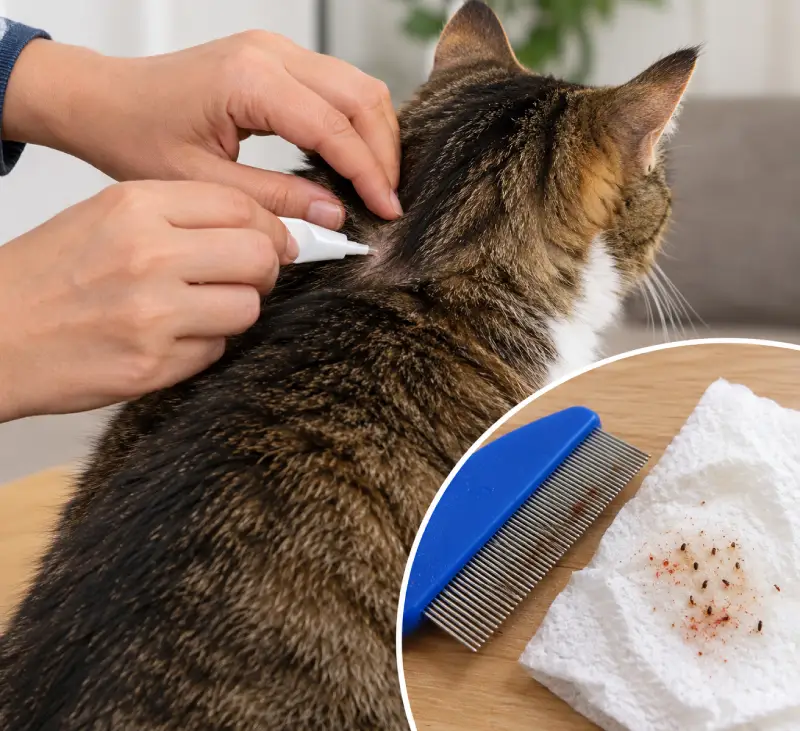
Itching has plenty of causes, and cats groom so thoroughly that they often swallow the evidence. Confirm the problem before you buy anything.
You need a fine-toothed flea comb and a sheet of damp white kitchen roll:
Other signs include over-grooming, thinning fur along the back, small scabs around the neck, and a cat who suddenly whips round to nibble at their rump. Some cats are allergic to flea saliva, and for them a couple of bites can trigger weeks of misery.
One flea on the comb matters more than it looks. Cats Protection estimates that adult fleas living on your cat make up only about 5% of the flea population in your home. The rest are eggs, larvae and pupae hiding in carpets, bedding and sofa cushions, and that shapes how you’ll need to treat.
For years the standard advice was simple: treat every cat, every month, all year. The current position from the British Veterinary Association (BVA), the British Small Animal Veterinary Association (BSAVA) and the British Veterinary Zoological Society (BVZS) is more considered. They advise against blanket treatment and in favour of assessing each animal’s risk. That doesn’t mean less protection for cats who need it. It means the right amount for each cat.
Here’s how common situations tend to play out. Your vet will fine-tune it.
| Your cat’s situation | Typical flea risk | What usually suits |
|---|---|---|
| Indoor-only cat in a flat, no other pets | Lower, but not zero | Monthly comb checks and prompt treatment if fleas appear; ask your vet whether ongoing prevention is worthwhile |
| Indoor cat living with a dog that goes out | Moderate | All pets treated on one plan set by your vet; the dog’s product must be permethrin-free |
| Outdoor cat or keen hunter | Higher | Ongoing prevention, usually alongside a worming plan |
| Several cats in one home | Higher, as fleas pass between cats | Every cat treated at the same time with a product suited to each |
| Cat with a flea allergy | A few bites can cause a severe reaction | Consistent prevention as your vet advises; stop-start treatment tends to backfire |
Indoor cats still get fleas, and flats are no exception. Fleas ride in on shoes, trouser hems and visiting dogs. They drift along shared hallways and stairwells. They wait in carpets left behind by a previous tenant’s pets, because flea pupae can lie dormant for months and hatch when warmth and vibration tell them a host has arrived. Central heating then gives them a comfortable climate all year.
So “indoor” lowers the risk without removing it. For a low-risk indoor cat, a sensible plan is a monthly comb check and a vet-recommended product used promptly at the first sign of fleas. That plan changes if your cat has ever had a flea allergy, or if a dog in the home goes out for walks.
Flea treatments are dosed by weight band, and cats drift between bands more than most owners realise. Weigh your cat before you buy: step on the bathroom scales holding them, then subtract your own weight, or ask your vet practice, as many will weigh a cat free of charge. Never split one pipette between two cats, and never use a bigger cat’s dose “to be safe”.
Every licensed product states a minimum age and weight on the pack. Many start at 8 weeks, some later, and a small number of sprays are licensed for very young kittens. Pregnant and nursing cats need a product specifically licensed for them, which makes this a conversation for your vet rather than a supermarket shelf.
Tell your vet about kidney or liver problems, any history of seizures, previous reactions to a flea product, and any other medicines your cat takes. As one example, the newer isoxazoline drugs (fluralaner, sarolaner and lotilaner) carry warnings about rare neurological reactions such as tremors or seizures, so a seizure history changes the choice. If your cat has reacted to a product before, write down its active ingredient and avoid it next time.
A product only works if it gets into your cat on schedule. A cat who eats anything will happily take a flavoured chew. A cat who spits tablets out of cheese might be better suited to a spot-on. A cat who fights both may do better with a collar or a longer-acting option. Be honest with yourself here, because missed and late doses are one of the commonest reasons treatment fails.
| Type | How it works | Good for | Watch out for |
|---|---|---|---|
| Spot-on | Liquid applied to the skin at the back of the neck | Cats who refuse tablets; wide choice, some also covering worms or ear mites | Must go on skin, not fur; bathing reduces it and washes it into waterways |
| Tablet or chew | Swallowed; fleas are killed when they bite | Food-motivated cats; no residue on the coat | Some cats refuse; a flea has to bite before it dies |
| Collar | Releases its active ingredients slowly over months | Cats who resist other forms | Most collars are weak; choose a quick-release clasp and check the fit weekly |
| Injection at the vet | Typically stops flea eggs developing rather than killing adult fleas | Hard-to-handle cats, as part of a wider plan | Won’t clear an active infestation on its own; not every practice offers it |
| Shampoos, powders and “natural” remedies | Varies | Very little | Weak or no evidence; garlic and many essential oils are toxic to cats |
Three of those rows need a closer look.
Collars. PDSA’s vets discourage most flea collars because they work poorly, with one exception: collars combining imidacloprid and flumethrin, which have been shown to work for seven to eight months. If you choose one, make sure it has a quick-release clasp so your cat can’t get caught on a branch or fence.
Fast-acting tablets. Tablets containing nitenpyram start killing adult fleas within about 30 minutes but protect for only around a day. They’re a useful first strike in a heavy infestation, paired with a longer-lasting product, rather than a plan on their own.
Natural remedies. PDSA states there’s no scientific evidence that diatomaceous earth, apple cider vinegar, garlic or essential oils work against fleas, and that garlic and many essential oils are poisonous to cats. A cat’s liver handles many plant compounds poorly, so “natural” is no guarantee of “safe”.
Brand names and packaging change; active ingredients don’t. Knowing a few helps you compare products and avoid repeating one that caused a reaction.
Every authorised veterinary medicine in the UK carries a distribution category code on the pack. It tells you who is allowed to supply it, and in practice it’s a rough guide to how much professional checking sits behind the sale.
| Code on the pack | What it means | Where you can buy it |
|---|---|---|
| POM-V | Prescription-only medicine, veterinarian | Your vet, or an online pharmacy using your vet’s written prescription; your vet must have examined your cat |
| POM-VPS | Prescription-only medicine, supplied by a vet, pharmacist or suitably qualified person (SQP) | Vets, pharmacies and SQP retailers |
| NFA-VPS | Non-food animal medicine, supplied by a vet, pharmacist or SQP | From behind the counter or a locked cabinet; you’ll be asked about your cat’s age, weight and history |
| AVM-GSL | Authorised veterinary medicine, general sales list | Anywhere, including supermarkets and online, with no questions asked |
PDSA advises using prescription products wherever you can. If that isn’t possible, it recommends products where the seller asks about your cat over off-the-shelf ones, which it describes as less reliable. Buying online? Look for the VMD’s Accredited Internet Retailer Scheme (AIRS) logo, and check any product’s category and licence on the VMD Product Information Database.
Many products containing fipronil and imidacloprid are still on general sale. That’s under review. The Veterinary Medicines Directorate (VMD) ran a call for evidence on whether these medicines should require professional advice at the point of sale, which closed on 11 June 2026.
In August 2026 the House of Lords Environment and Climate Change Committee went further, calling for an end to the general sale of off-the-shelf and unchecked online flea and tick treatments, and for owners to receive a proper assessment of their pet’s needs.
When we last checked in October 2026, the VMD had not announced a decision. The supermarket product you bought last year may soon come with a conversation at the counter, so we’ll update this guide when the outcome is published.
The recent changes came from rivers rather than cats. Environment Agency monitoring has found fipronil and imidacloprid in UK waterways at levels that could harm aquatic insects such as mayflies and dragonflies, and VMD-funded research shows these chemicals get there through household wastewater and when treated pets swim. Both are already banned as farm pesticides.
Cats rarely swim, but they do get bathed, groomed and stroked, and every wash after a spot-on sends some of it down the drain. In October 2025 the BVA, BSAVA and BVZS updated their joint position, recommending that, where possible and reasonable, topical products aren’t used on pets likely to swim or be bathed after treatment.
The VMD’s “Plan. Apply. Protect.” campaign, launched in May 2026, sums up the habits that help:
These steps also help the treatment do its job. A spot-on smeared into fur, or washed off a week later, isn’t protecting your cat.
Treating your cat kills the adult fleas that land on them. It does nothing about the eggs, larvae and pupae already in your carpets, which is why so many owners give up on a product that was actually working.
A practical home plan:
Expect the odd flea for several weeks. Pupae are protected inside their cocoons, so they keep hatching after you’ve treated, and a newly emerged flea usually has to bite before the product can kill it. A well-established infestation can take two to three months of consistent treatment to clear. Spotting a flea in week three doesn’t mean the product has failed.
Before switching products, run through the usual culprits:
If none of those explain it, talk to your vet, who can switch your cat to a product with a different active ingredient. If you think a product hasn’t worked, or your cat has had a reaction such as skin irritation where it was applied, drooling, vomiting or lethargy, your vet can report it to the VMD, and you can also report it yourself on GOV.UK. Those reports are how problems with veterinary medicines come to light.
Not automatically. Indoor cats can still get fleas, so they need regular checks and a plan. Whether that plan includes year-round prevention depends on the other animals in your home, whether your cat has a flea allergy, and how often fleas have turned up before. Your vet can set a schedule based on that risk.
It depends on the product’s licence. Many products start at 8 weeks and a minimum weight, and a few are licensed for younger kittens. Never use an adult product on a kitten, and speak to your vet before treating a kitten under 8 weeks old.
Often, yes, but check with your vet first. If either product is new to your cat, your vet may suggest leaving a few days between them so you’ll know which one caused any side effect. Cats also pick up tapeworm by swallowing fleas while grooming, and few flea products cover tapeworm, so a cat with fleas usually needs a wormer too.
Usually not. PDSA notes that flea shampoos often don’t kill fleas effectively, most cats hate being bathed, and washing can reduce how well a spot-on works.
No. They’ll bite people, often around the ankles, but they can’t live on humans. Bites on your legs are a strong hint that fleas are living in your home.
Sometimes. A cheap product that doesn’t clear the fleas means more weeks of itching, a home infestation to tackle and often a vet visit anyway. Comparing the cost per month of protection across products your vet recommends is a fairer test than the price of a single pack.
Sources: