
Here’s the thing that trips up every dog person who meets a cat: a wagging tail is not a happy tail. In dogs, the wag mostly means friendly excitement. In cats, tail movement mostly tracks arousal, how worked up the cat is, and the faster and harder the tail moves, the less happy the situation usually is. A cat’s tail is closer to a mood gauge than a greeting.
The good news is that tail language is remarkably consistent once you know the vocabulary. Below is each movement you’ll actually see, what it tends to mean, and the handful of tail signals that mean ring the vet rather than reach for a translation.
Before the dictionary, one principle that decodes most of it on its own. Watch two things: how fast the tail is moving and how high it’s carried. Slow and high tends to be positive or curious.
Fast, hard and low tends to be agitation. A still, softly upright tail is a comfortable cat; a tail cracking side to side like a whip is a cat asking you, firmly, to stop whatever is happening.
Charities like International Cat Care and Cats Protection teach body language exactly this way: read the whole cat, but let the tail set your first guess.
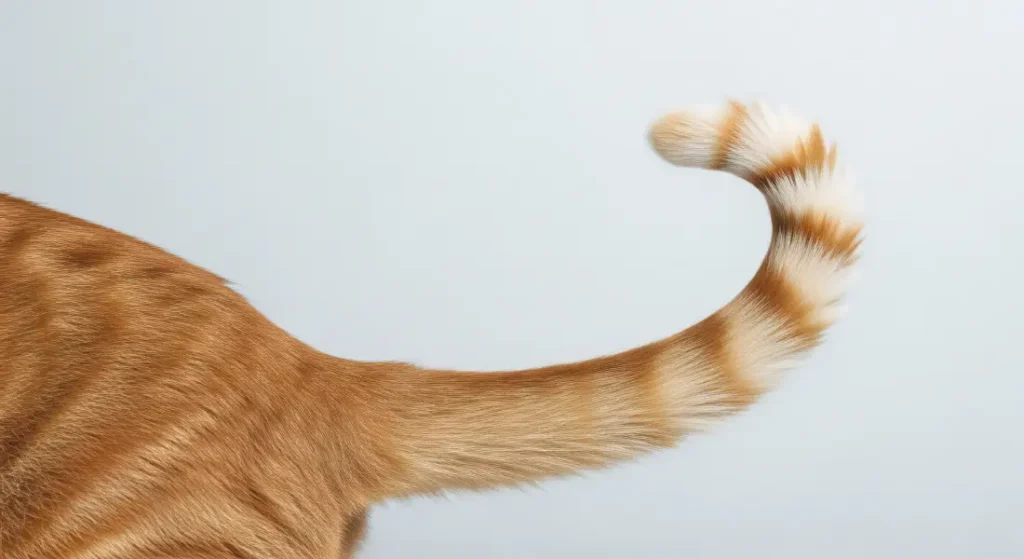
The classic friendly greeting. Tail vertical, tip softly hooked like a question mark, often aimed straight at you as the cat trots over. This is as close as cat language gets to a wave, and it’s an invitation to interact. Kittens greet their mothers this way; adult cats kept it for the humans they like.
A vertical tail that trembles or shivers from the base, usually at a reunion or just before dinner. It looks faintly ridiculous and it’s one of the warmest signals a cat sends.
One honest footnote: cats use the same quivering posture when they urine-mark standing up, so if you’re seeing it aimed at a wall rather than at you, and especially with backing up involved, read our guide to what’s really happening in why cats pee outside the litter box. Context separates the two instantly: quiver at your ankles, affection; quiver at the curtains, investigate.
Swinging hard side to side, or slapping the floor, the tail becomes the clearest no in the language. Something has pushed the cat past comfortable: too much stroking, another cat, a grooming session that’s gone on too long.
Thrashing is not a prelude to play. It’s the warning that comes before the hiss or the nip, and respecting it is how you earn a cat’s trust. Stop the interaction, give them space, and let the tail settle.
This is also the answer to the eternal question of why a cat “suddenly” bites mid-stroke. It’s almost never sudden; the tail was broadcasting for a good thirty seconds first. Watch for the tail starting to flick as you stroke, quit while you’re ahead, and the biting largely stops happening.
Just the last few centimetres flicking while the rest of the tail stays still means focus. You’ll see it at the window when a pigeon lands, mid-play before a pounce, or while they stare at the laser dot. It’s concentration with the engine running. That same tip-twitch during stroking, though, is early irritation, the gentle version of the thrash above. The difference is what the cat is looking at: prey, excitement; you, warning.
A wide, slow, deliberate sweep, usually with the body low and the eyes locked on something, means stalking. Cats do it before they ambush a toy, a housemate or your ankles on the stairs. It often comes with a little bottom wiggle before launch. During play this is exactly what you want to see; it means the game is working.
Fur standing on end down the tail, often with an arched back, is a startled cat making itself look bigger. This isn’t aggression; it’s alarm. Don’t pick up or corner a cat in this state, however comic the silhouette. Let them retreat, work out that the dropped saucepan isn’t a predator, and deflate in their own time.
A tail tucked tight under the body says fear or pain: make the world smaller and calmer. A tail wrapped around another cat, or curled over your arm on the sofa, is affiliative, the feline equivalent of an arm around a shoulder. And a tail draped loosely around their own paws while sitting is a comfortable, composed cat watching the world. Not every tail message is a drama.
Common, and usually nothing. Cats process sounds while dozing and twitch through dream sleep the same way dogs and humans do, so a flicking tail tip on a sleeping cat is ordinarily just a busy brain. The exception worth noticing is a cat that looks settled but whose tail thumps steadily while fully awake and lying flat; that pattern is covered below.
Three tail patterns earn a phone call rather than a translation. A cat lying down, otherwise still, with the tail swishing or thumping persistently, particularly alongside hiding, lethargy or going off food, can be signalling pain, and cats are expert at hiding pain everywhere except the tail.
A limp, dragging or oddly kinked tail means possible injury and is a same-day call; tails are full of nerves that matter. And repeated episodes of rippling skin along the back with sudden violent tail-lashing and frantic grooming deserve a proper work-up, since vets have a condition on their radar for exactly that picture.
None of this is diagnosis by blog; it’s knowing which tail movements deserve professional eyes. Behaviour changes often show up around the litter tray at the same time, which is why we treat the tray as a health dashboard worth glancing at daily.
The tail sets your first guess; ears, eyes, whiskers and posture confirm it. An upright tail with soft eyes and forward ears is a greeting. An upright puffed tail with saucer pupils and flat ears is a very different conversation. Sound completes the picture, and we’ve decoded that half of the language in what every meow, chirrup and yowl means.
Between tail and voice, very little your cat says is actually mysterious; they’re talking constantly. We just arrive not speaking the language, and the tail is the fastest part to learn. Even the strange rituals have grammar: the vigorous digging that kicks litter all over your floor is communication too, in its own maddening way.
Why does my cat wag its tail while purring?
Because purring isn’t only contentment; cats also purr to soothe themselves when stressed or sore. A soft tail with a purr is a happy cat. A lashing tail with a purr means the purr is doing comfort work, so ease off and give them space.
Why does my cat wag its tail while lying down?
Relaxed tip-flicking while they watch the room is normal idle attention. Persistent thumping from a cat that’s otherwise flat and withdrawn is worth reading alongside the pain signs above.
Why does my cat wag its tail when I stroke it?
That’s the overstimulation meter filling up. The flicking starts gentle and builds; stop at the first flicks and you’ll stay on the right side of the nip. Short, frequent strokes beat long sessions for most cats.
Do cats ever wag their tails because they’re happy?
The upright quiver and the hooked-tip greeting are as close as it gets, and both are genuinely warm signals. The dog-style broad happy wag, though, isn’t in the feline dictionary; a big fast wag on a cat is nearly always the opposite.