
Some cats will hold an entire conversation with you across the kitchen. Others go weeks saying almost nothing, then produce one enormous yowl at four in the morning and leave you lying there wondering what on earth that meant.
Both are normal. What matters is learning to read your own cat, because there is no universal feline dictionary. Your cat has worked out, over months of trial and error, which noises get results from you specifically.
This guide covers what the research actually shows, how to decode pitch and length, and the small number of vocal changes that should send you to the vet rather than to Google.
A meow most often functions as a request rather than a statement of mood: let me in, feed me, look at me, open this door.
Adult cats developed meowing almost exclusively for communicating with humans. Cats Protection is blunt about it: pet cats usually only meow to communicate with people, and they have learnt that we respond by giving them what they want. Between themselves, cats rely on body language and scent, which work at a distance and do not announce your position to every predator in the area.
Kittens are the exception. They mew at their mother from a few days old to signal hunger or distress, and Cats Protection notes that most stop at around two to three months. What happens next is the interesting part. In a house with humans, that kitten call never really goes away. It gets refined instead, shaped by which versions of it produce food, a lap or an open back door.
So when your cat meows at you, they are not speaking cat. They are speaking you.
Domestic cats descend from the African wildcat, a solitary animal with no need for a chatty social vocabulary. That ancestry is why cats did not arrive with the ready-made social communication skills dogs and humans have.
Meowing filled a gap that only appeared once cats moved in with us. Scent marks and tail positions are wasted on a species that cannot smell pheromones and routinely misreads an ear twitch. Sound cuts through.
There is evidence the sound itself changed to suit us. Comparative work by Nicastro found that meows from domestic cats were rated as more pleasant by human listeners than those of African wildcats, which fits the idea that thousands of years of living alongside people selected for a call we find easier to tolerate and respond to.
Cats do still vocalise to each other, just rarely and in specific circumstances. Mothers and kittens use mews, chirrups and trills. Unneutered cats yowl to find a mate. Cats in conflict hiss and growl. Outside those situations, a meow aimed at another cat in your house usually means the two of them are not getting on.
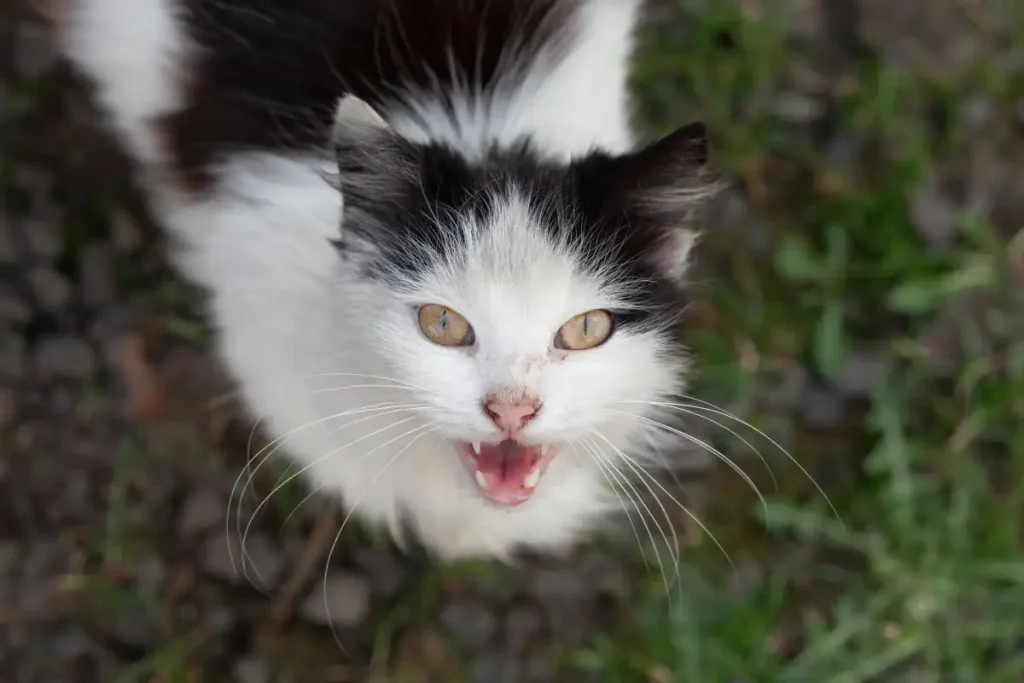
Here is the working vocabulary, roughly in order of how often you will hear it.
| Sound | Usual meaning | What to do |
|---|---|---|
| Meow | A request. Attention, food, access | Respond to the need, not the noise |
| Mew | Kitten call to mum. Hunger or distress | Check warmth, feeding, security |
| Chirrup or trill | Friendly greeting | Greet back. Cats often respond to it |
| Chatter | Frustrated hunting excitement at prey out of reach | Nothing. Offer a play session |
| Purr | Usually contentment. Sometimes self-soothing under stress or pain | Read the context, not the purr alone |
| Yowl | Drawn out. Mating, conflict, disorientation or distress | Investigate. Sudden yowling needs a vet |
| Growl | A warning before an attack | Back off and give space |
| Hiss or spit | Defensive. Leave me alone | Stop what you are doing immediately |
The everyday request. Cats Protection describes how a cat develops a personal range of meows that their owner learns to recognise, often a short one for attention and a longer one for food, because the owner’s response teaches the cat which version works.
That is worth sitting with. If your cat has a specific “breakfast noise,” you built it together.
A short rolled trill, the sound a mother cat makes to call kittens to her. Plenty of cats redirect it at humans as a greeting. It is one of the few cat sounds you can copy back with reasonable success.
Teeth going at speed while your cat stares at a blackbird through the window. Frustration, essentially, at prey they cannot reach. Harmless, and usually a sign your cat wants more to do. A hunting-style play session with a wand toy tends to settle it.
Purring usually means a relaxed cat. It does not always. Cats also purr when frightened, unwell or in pain, apparently as self-soothing, which is why Cats Protection advises reading the context of a purr and checking with a vet if something feels off.
Then there is the manipulative one, and that has actual British research behind it.
Karen McComb at the University of Sussex noticed her own cat, Pepo, waking her every morning with a purr she found impossible to ignore, and decided to work out why.
Her team recorded ten cats purring in different circumstances, levelled the volume, and played the recordings to fifty listeners. People consistently rated the purrs recorded while cats were seeking food as more urgent and less pleasant than purrs recorded at rest, and they did this even when they had never owned a cat. Cat owners were slightly more accurate, but the effect held for everyone.
The reason turned out to be structural. Buried inside the low rumble of the “solicitation” purr was a high-frequency voiced component around 380 Hz, sounding rather like a cry or a meow. When the researchers re-synthesised the purrs to strip out that one element and left everything else intact, listeners rated them as significantly less urgent.
The published interpretation is that cats are tapping into a mammalian sensitivity to infant distress cues, wrapped inside a sound we associate with contentment. It is a more socially acceptable way of demanding breakfast than sitting on your head.
If your cat’s morning purr feels physically difficult to sleep through, that is not you being soft. It is doing exactly what it evolved to do.
Once you stop asking what does a meow mean and start asking what does this particular meow mean, three dials do most of the work.
Pitch: This is where the acoustic research gets genuinely useful. Schötz and colleagues at Lund University analysed 780 meows from 40 cats across six contexts and four mental states. Positive situations tended to produce meows with rising pitch contours. Negative or stressed situations produced predominantly falling ones.
You can hear it once you know to listen for it. The upward-tilting “mrrp?” at the door is a different animal from the descending “meeeaowww” that trails off downwards. One is a greeting. The other is a complaint.
Length: Short sounds are social. Long sounds are demands. A clipped chirp as you walk past is acknowledgement; a drawn-out call is a request that has not yet been met.
Repetition: Rapid-fire repeats signal urgency and rising frustration. A cat repeating themselves is a cat who does not think you have understood, and as they escalate, meows often drop in pitch and grow more insistent until they get the response they wanted.
Three dials, eight or nine combinations, and after a fortnight of paying attention you will know your own cat’s set.
Your cat opens their mouth, the whole meow face happens, and no sound comes out.
You will read all over the internet that this is a real sound pitched too high for human ears. Treat that claim carefully. It gets repeated confidently across pet blogs and even some brand sites, but it is not well supported by published acoustic work on cat vocalisation, and cats do not generally produce meows in the ultrasonic range.
The likelier explanation is simpler. It is a very quiet meow, sometimes barely voiced at all, usually aimed at a human who is already looking. Some cats reserve it for close-range, high-affection moments, when a full-volume meow would be overkill.
Worth one caveat: if a normally vocal cat’s voice becomes suddenly hoarse or disappears entirely, that is a change in your cat’s voice, and changes get checked. See the vet section below.
Sudden is the important word. A Siamese who has talked non-stop for nine years is a Siamese. A quiet moggy who becomes vocal in a fortnight is telling you something has changed.
Common causes, roughly in order of how often they turn out to be the answer:
Hunger and routine: Meal times shifting, a new food, or a household member who has started free-pouring biscuits.
Attention and learned behaviour: The most under-diagnosed cause. If meowing has ever produced food, a door opening or eye contact, it is now a working strategy. It is not manipulation in any sinister sense. It is your cat being an efficient learner.
Stress and change: A house move, building work, a new baby, a new cat in the garden, fireworks. UK cats get a concentrated dose of this every autumn.
Boredom: Particularly in indoor-only cats and in winter, when the days are short and the cat flap sees less use.
Not being neutered: Unneutered cats yowl to find and attract a mate, and the sound carries a long way. Neutering can reduce or stop it, though a habit that has been established for a while may take longer to fade. Your vet can advise on timing.
Age: Older cats can develop cognitive dysfunction, which is broadly similar to dementia. It can produce unexpected and often loud meowing, particularly when the cat is alone, alongside confusion, disorientation, changes in sociability and disrupted sleep patterns. This one needs a vet, not a behaviour plan.
Pain or illness: Always on the list. Never the assumption to rule out last.
Night-time vocalising has its own set of causes, and they sort into three groups.
Natural rhythm: Cats are crepuscular. Dawn and dusk are their built-in activity peaks, which in a British winter means your cat’s alarm clock goes off at half past four in a pitch-dark bedroom.
Environment: A cat who used to go out at night and now cannot will protest, and the protest can run for weeks. Another cat in the garden, visible through a window, can set off yowling from indoors. If your cat has a cat flap, a neighbourhood cat coming through it is a genuinely common cause of 3am chaos.
Age and health: Loud night-time calling in an older cat, especially when they seem disoriented or are pacing, points towards cognitive decline or an underlying condition. It is one of the most common presentations that turns out to be medical.
Practical things that help: a substantial play session before your own bedtime, a portion of the daily food ration held back for last thing at night, blackout curtains if a garden cat is the trigger, and a warm sleeping spot that is not your pillow. What does not help is getting up. Getting up teaches the cat that yowling summons a human, which is precisely the lesson you are trying not to teach.
This one gets skipped by most guides and it is the one where getting it wrong costs the most.
Some cats simply announce themselves. A cat who has always chirped before or after using the tray, and is otherwise well, is probably just being themselves. Some cats also feel vulnerable while toileting and are calling you over to stand guard.
But vocalising in the tray can also mean pain, and the underlying causes are serious.
PDSA lists crying or straining while peeing among the signs of a urinary tract problem, and is emphatic that a cat who is trying to pee but passing nothing, in pain and distressed, is an emergency needing an urgent appointment. This should never be left to see whether it improves. Male cats are at higher risk because of their narrower urethra.
Meowing while pooing is on PDSA’s list of constipation signs too, indicating that it is painful, usually alongside straining for longer than usual, repeated trips in and out of the tray, or very hard, small stools.
Call your vet the same day if you see:
Once a vet has ruled out a medical cause, the tray setup itself is worth a look. The standard guidance is one tray per cat plus one spare, placed on separate routes rather than lined up in one room. Trays should be big enough for a full turn and a comfortable squat, with a low entry for older or arthritic cats. Dirty trays, scented litters and sudden changes of litter type all put cats off, and a cat avoiding the tray can end up constipated as a result.
Litter texture matters more than most owners expect, particularly for cats with sore paws or joints. Our own olive pit litter is made from 100% upcycled olive pits, clumps strongly and is low in dust, which makes daily scooping straightforward and keeps the tray consistently fresh. If dust is your concern specifically, we compare the UK options in our dust-free litter guide, and there is a separate guide to the safest choices for kittens.
The trick is separating the need from the noise. You are not trying to silence your cat. You are trying to stop meowing from being the thing that works.
Meet the need first: Check food, water, a clean tray, an accessible cat flap and something interesting to do. Persistent meowing from a cat whose basic needs are unmet is not a behaviour problem, it is a valid complaint.
Reward the quiet, not the noise: Feed, open the door or offer attention in a gap between meows rather than during one. If your cat calls at a closed door, wait for a moment of silence before opening it. Otherwise you are teaching them that volume is the key.
Do not respond halfway: Getting up at 5am to shush your cat is still getting up. From the cat’s side, the experiment worked.
Break the pattern properly: Expect it to get louder before it gets quieter. A behaviour that has been reliably reinforced for years does not fade in a weekend, and the cat will try harder before trying something else.
Add enrichment: Two short play sessions a day, puzzle feeders, a window perch. Most demand meowing in indoor cats is boredom with a soundtrack.
Get help if it is anxiety: If the meowing looks like distress rather than demand, particularly when the cat is alone, a qualified clinical animal behaviourist is the right call. Your vet can refer you.
The single most useful rule in this entire guide: the change is the signal, not the sound.
Book an appointment if you notice:
Sudden yowling is treated seriously by vets precisely because it is so often linked to pain, illness, anxiety or cognitive decline rather than to mood.
Since no two cats share a vocabulary, the fastest way to understand yours is to build the dictionary yourself. This takes about two minutes a day.
For one week, every time your cat vocalises, note four things:
By day four or five, patterns show up. Most cats turn out to have somewhere between four and seven distinct sounds, each tied to a specific request, and the rising or falling pitch pattern becomes obvious once you are listening for it.
Recording a few on your phone helps, because you can compare them side by side rather than relying on memory. It also gives you something concrete to play to your vet if a sound ever worries you, which is far more useful than trying to imitate a yowl across a consulting room.
Do cats understand when we talk to them?
They recognise a good deal more than people assume. Research by Saito and colleagues found that domestic cats can distinguish their own name from other similar-sounding words. Tone and familiarity carry most of the meaning.
Is it “miaow” or “meow”?
Cats Protection treats miaow as the umbrella term for a group of cat sounds including the meow and the mew, and suggests using “miaow” if you are unsure which you are hearing. Both spellings are correct in British English.
Why does my cat meow at the other cat in the house?
If both are neutered, that usually means they are not getting along, and each needs space to get away from the other. If either is unneutered, it may be mating-related.
Should I meow back?
It will not translate, but it will not hurt. Copying a chirrup often gets a response, since it is a friendly greeting sound in the first place. Many cats will develop a back-and-forth exchange with an owner who reliably answers.
Are some breeds louder than others?
Yes. Siamese and other Oriental breeds are known for being vocal, and individual personality varies enormously within any breed. Judge your cat against their own baseline, not against a breed profile.
Can my cat’s meowing be a sign of pain?
It can. Vocalising when touched or lifted, crying in the litter tray, or a new pattern of yowling all warrant a vet check. Cats are famously good at concealing pain, so a change in voice is sometimes the first visible clue.
This article is for general education and is not a substitute for veterinary advice. If you are worried about your cat’s behaviour or health, contact your vet.