
You sweep the kitchen, and an hour later there’s a gritty trail leading from the litter tray to – somewhere. The hallway. Under the sofa. Worst of all, your bed. If you’ve started finding stray granules in rooms your cat barely visits, you’re dealing with litter tracking, and you’re very much not alone.
Here’s the honest bit most guides skip: you cannot eliminate tracking entirely. A cat digging and kicking is doing exactly what millions of years of instinct tell it to. But you can cut the mess dramatically – most owners who fix the right things see the scatter drop by something like ninety percent. The trick is figuring out which fix your particular situation needs, rather than throwing every product on the market at the problem.
This guide does that. We’ll show you why litter spreads in the first place, help you diagnose where yours is escaping, and walk through every fix that works – from the litter itself to mats, boxes, grooming, and a few free tricks that cost nothing at all.
Litter doesn’t move on its own. It hitches a ride, and it does so in two distinct moments. Understand both and every fix that follows makes sense.
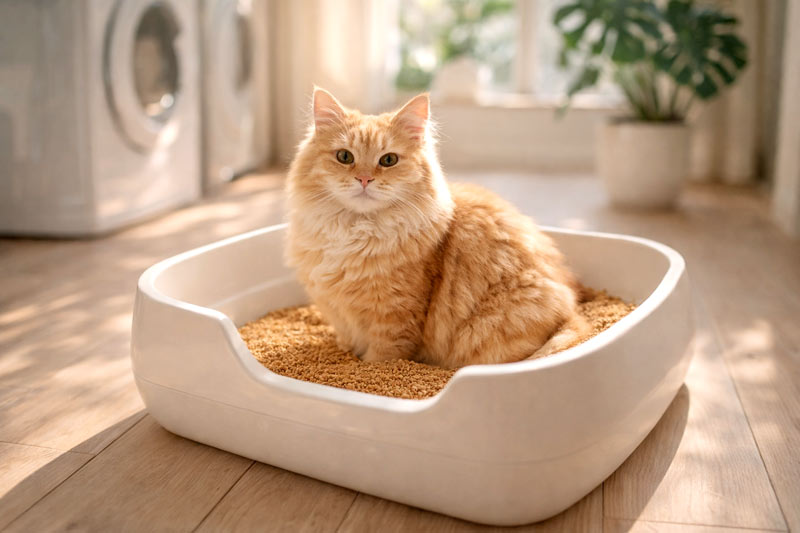
Before and after using the tray, your cat digs. In the wild, burying waste hides a cat’s scent from predators and rivals, and your thoroughly domesticated sofa-loafer still runs the same software. That vigorous scraping flings the lightest, finest granules up over the rim and out onto the floor. Enthusiastic diggers – and cats who treat covering their business like an Olympic event – throw litter the furthest. This is the scatter you find near the box.
The second moment is the getaway. As your cat steps out, granules lodge between its toes and in the pads of its paws, then drop off one by one as it walks. This is the trail you find feet or rooms away from the tray.
Fine, sandy, or damp litter is the worst offender because small rough particles grip skin and fur far more stubbornly than large smooth ones. Long-haired cats have it worse still – litter tangles into the fur between their toes and gets carried like a passenger.
Almost every spreading problem is some mix of these two. Which one dominates in your home tells you which fix to reach for first.
Before you buy anything, spend a day noticing where you find the litter. The location is a fingerprint that points straight at the cause.
| Where you find it | What’s causing it | The fix to try first |
|---|---|---|
| Piled right at the rim / just outside the box | Energetic digging and kicking | Higher-sided or top-entry box; reduce fill depth to 2–3 inches |
| A trail several feet away or into other rooms | Granules stuck in paw pads and fur | Larger, smoother, low-tracking litter; a bigger mat; trim paw fur |
| Fine dust film on nearby surfaces | Dusty litter going airborne when kicked | Switch to a genuinely dust-free litter |
| Worse after you’ve topped up the tray | Tray overfilled | Keep litter at 2–3 inches, no more |
| Suddenly worse than usual | New litter, a draught, or box now in a damp/busy spot | Check recent changes; move box off draughts and away from humidity |
| Clinging to one long-haired cat in particular | Fur between the toes | Regular paw-pad trims |
Match your symptom to a row and you’ll waste far less money than the owner who buys a covered box when their actual problem was sandy litter sticking to paws.
Everyone reaches for a mat first. But the single biggest lever on tracking is the litter you’re putting in the tray, because the physical properties of the granule decide how easily it travels. Get this right and every other fix has less work to do.
Three properties matter.
Size: large granules are too big and heavy to wedge into paw pads or get flung far, so they stay put. Fine, sandy litters cling and scatter.
Surface and density: smooth, dense granules don’t grip skin and fur the way small rough particles do, and they’re heavy enough to resist being kicked airborne.
Dust: low-dust or fully dust-free litter doesn’t throw up a cloud when your cat digs, so nothing settles on nearby surfaces or coats your cat’s coat to be carried off later.
Pellet litters (wood, paper) score well on size and are a common anti-tracking pick, though many don’t clump and some cats dislike the hard texture underfoot. This is also where olive pit litter has a natural advantage: the granules are dense, smooth, and effectively dust-free, so they’re heavy enough to stay in the tray when kicked and too smooth to cling to paws on the way out. In our own tray tests the difference against fine clay is obvious – far fewer granules make it past the mat.
Here’s the catch nobody warns you about: the best low-tracking litter in the world is useless if your cat refuses to use it. Cats are deeply suspicious of sudden change to their toilet, and an abrupt swap can mean accidents on your floor – a worse mess than the one you started with.
Switch gradually over about three to four weeks. Start with roughly 75% of the old litter and 25% of the new, then move to half and half, then 75% new, then fully across – shifting the ratio about once a week. If your cat hesitates at any stage, just hold that mix for a few extra days before going further. Slow enough and most cats never even notice the handover.
If diagnosis pointed you at digging and rim-scatter, the box is your lever. Each style trades containment against other quirks, so pick for your cat.
A high-sided box is the simplest win – tall walls catch kicked litter that an open low tray lets fly, and most cats accept them without fuss. A top-entry box, where the cat jumps in and out through a hole in the lid, is excellent at containment and has a bonus: the act of climbing out knocks loose granules off the paws before your cat hits the floor. The trade-off is that kittens, seniors, and arthritic cats can struggle to climb in.
A covered or hooded box physically walls in the scatter and adds privacy many cats appreciate. The honest downside is odour – a hood traps smell inside, so it needs more frequent scooping, and some cats dislike the closed-in feeling. And don’t overlook the simplest option: a bigger box. Cats frequently outgrow the tray they were bought as kittens. A box around one and a half times your cat’s body length gives room to dig and turn without flinging litter over the edge.
A mat is the classic fix, but “buy a mat” is incomplete advice, because the wrong mat does almost nothing. What you want is a mat that actively pulls granules off the paws and holds them.
Honeycomb or channelled mats outperform flat ones: the pockets catch litter as your cat walks across and trap it below the surface, so it doesn’t just get pushed around. Two-layer designs take it further – granules fall through the top layer into a hidden reservoir you tip back into the tray. Size matters more than people think; the mat needs to be big enough that your cat takes at least two or three steps on it before reaching the floor, so one tiny mat at the box’s edge won’t cut it. Choose one that’s washable and easy on the paws, because a mat your cat hates to step on gets avoided entirely.
Placement is half the job. Put the mat directly against the box’s exit so it’s the unavoidable first thing those litter-laden paws touch. If your cat uses a top-entry box, the mat goes wherever it lands after jumping down.
For long-haired cats, the fur tufting out between the toes is a litter magnet – it scoops granules straight out of the tray and ferries them across the house. Keeping that fur trimmed is one of the most effective and most overlooked fixes for fluffy breeds.
You can do it at home with rounded-tip safety scissors or a small quiet trimmer: gently hold the paw, press to fan out the toes, and trim the fur level with the pads – never poke anything between the toes, and stop the moment your cat tenses up. Once every few weeks is usually enough to keep tracking down. If your cat won’t tolerate having its paws handled, or you’re nervous about the scissors near delicate skin, a groomer or vet nurse will do it quickly and safely, often as part of a routine tidy-up.
Some of the most effective changes cost nothing. Start with depth: two to three inches (5–7cm) is the sweet spot. Overfill the tray and the surplus simply gets kicked out and rides on paws; too shallow and your cat digs to the bottom and scrapes litter over the side. Most people who think they have a litter problem actually have a too-much-litter problem.
Where the box sits matters just as much. Keep it on a hard, level floor rather than carpet – granules lift off tile and laminate with a quick sweep but bury themselves in pile. Avoid draughty spots, since air from vents and doorways carries dust and light granules around the room. Steer clear of damp rooms too: a box near a shower or humidifier lets moisture make the litter tacky, so it clumps onto paws and tracks worse. A quiet, low-traffic corner on a wipeable floor is the free upgrade most homes have room for.
You don’t need to spend much to contain litter. A plastic boot tray or shallow under-bed storage box placed under the litter tray catches a surprising amount of overspill and wipes clean in seconds. A cheap rubber-backed bath mat or door mat stands in perfectly well for a pricey litter mat – the textured kind grabs granules off paws just fine. Some owners set the tray inside a larger plastic storage tub with a doorway cut into one side, turning a basic open tray into a high-walled, scatter-catching box for a couple of pounds. None of these will win a design award, but they work, and they prove you don’t have to buy specialist kit to get your floors back.
Pull the threads together and the litter you choose is doing a lot of the heavy lifting. This is where olive pit litter earns a mention, and it’s earned honestly: the granules are dense and smooth, so they don’t cling to paw pads or fur the way fine, rough grains do, and they’re heavy enough to stay in the tray rather than flying out when your cat digs. Because the material is effectively dust-free, there’s no fine cloud settling on nearby surfaces or coating your cat to be carried off later.
OliveScoop makes exactly this kind of litter from upcycled olive pits, and we ship it across the UK. It won’t make tracking vanish – nothing will – but as the litter half of your anti-tracking setup, dense dust-free granules give your mat and your box far less to deal with.
Litters with large, smooth, dense, low-dust granules track least – fine, sandy, lightweight litters track most. Pellet litters and dense granular litters like olive pit resist wedging into paw pads and don’t go airborne when kicked.
Yes, if you pick the right one. Honeycomb or two-layer mats trap granules pulled off the paws far better than thin flat mats. The mat also needs to be large enough that your cat takes a few steps on it before reaching the floor.
It helps a lot with kicked-out scatter, since the hood walls in the mess. The trade-off is that covered boxes trap odour and need more frequent scooping, and some cats dislike the enclosed feel.
Trim the fur between the paw pads every few weeks so granules can’t tangle in it, pair that with a low-tracking litter, and use a good mat at the box exit. A groomer can handle the trimming if your cat won’t sit for it.
Look for a recent change – a new litter (often finer or dustier), an overfilled tray, or the box moved somewhere draughty or damp. Damp air makes litter tacky so it clings to paws, and draughts blow light granules around.
It’s mostly a hygiene nuisance – granules on bare feet, in bedding, occasionally near food prep areas. Dusty clay litters add a respiratory irritant to the mix, which is one more reason a dust-free litter is worth the switch.
Litter tracking is a solvable annoyance, not a life sentence – as long as you treat the actual cause rather than guessing. Spend a day noticing where the granules land, match that to the diagnosis, and fix that specific leak: a containing box for kickers, a proper mat and low-tracking litter for paw-trailers, a paw trim for fluffy cats, and the free wins of correct depth and smart placement for everyone.
Get the litter right and the rest gets easier. Dense, smooth, dust-free granules resist both ways litter escapes, which is why your choice of litter is the foundation everything else builds on. If you want that foundation sorted, OliveScoop delivers low-tracking olive pit litter to your door across the UK – and your skirting boards will thank you.