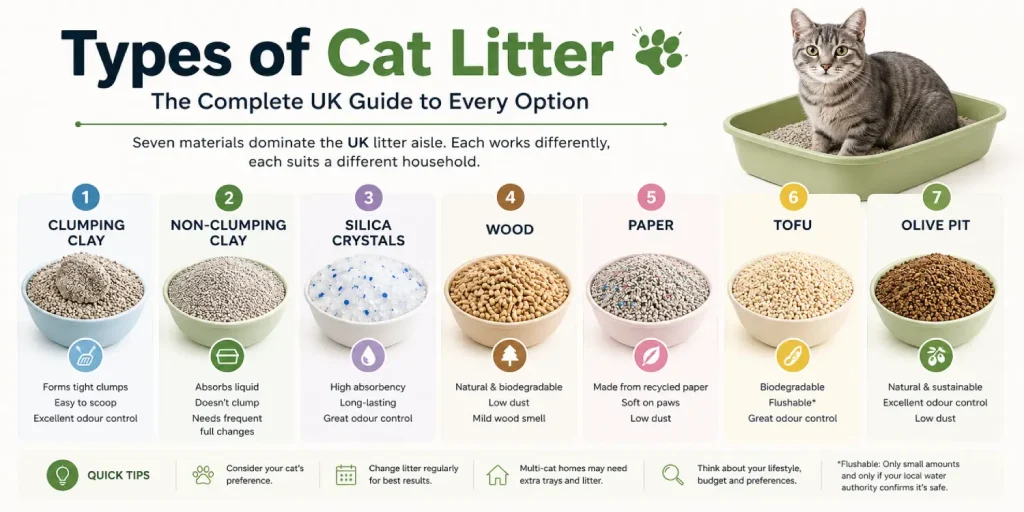
Seven materials dominate the UK litter aisle: clumping clay, non-clumping clay, silica crystals, wood, paper, tofu and olive pit. Each works differently, each suits a different household, and the wrong pick is one of the most common reasons a cat starts avoiding the tray.
This guide explains how every type actually works, its honest pros and cons, and who it’s best for, so you can choose on substance rather than packaging.
The default litter of the last few decades. Made from bentonite clay, which swells dramatically on contact with liquid, it forms hard, scoopable clumps within seconds.
How it works: the clay absorbs urine and binds into a solid mass you lift out, leaving the rest of the tray clean.
Pros: the firmest clumps of any material, cheap per bag, sold everywhere, and its fine sandy texture is close to what cats instinctively dig in. Feline veterinary guidance consistently notes most cats prefer exactly that: fine, sand-like, unscented.
Cons: it’s the dustiest common litter by a distance, it’s heavy to carry, it’s strip-mined rather than renewable, and it can never be composted. Swallowed in quantity it swells, which is why it’s not for young kittens.
Best for: owners who want maximum clump strength at minimum cost and don’t mind the dust and weight.
The original cat litter, and still on every supermarket shelf. Absorbent clay granules soak up liquid without binding together.
How it works: urine soaks through the litter bed and is held in the granules until you change the whole tray.
Pros: the cheapest bag on the shelf, and simple.
Cons: you can’t remove urine selectively, so smells build and the entire tray needs emptying frequently, which quietly erases the price advantage. Still dusty, still heavy, still landfill-only. We’ve compared the two clay approaches properly in clumping vs non-clumping cat litter.
Best for: short-term use, or the rare cat with a firm texture preference for it.
Those translucent beads and crystals, made from silica gel, the same material as the sachets in shoe boxes.
How it works: highly porous crystals trap liquid and odour internally, drying out solids; instead of clumping, the whole tray is replaced every few weeks.
Pros: excellent absorbency per kilogram, lightweight, low maintenance between changes, and some versions change colour as they saturate.
Cons: many cats dislike the sharp, unnatural feel underfoot, the crystals can crackle as they absorb, it’s not biodegradable, and quality varies wildly between brands. Some owners come looking for a change precisely because of the texture; our guide to alternatives to silica gel crystals exists for them.
Best for: low-maintenance households whose cats genuinely tolerate the texture.
Compressed pine or mixed softwood, most often sold as pellets, occasionally as clumping granules.
How it works: pellets absorb urine and break down into sawdust, which sifts to the bottom of the tray; you remove the sawdust rather than clumps.
Pros: renewable material, naturally pine-scented, cheap, low dust in pellet form.
Cons: the sawdust maintenance style divides opinion, pellets feel chunky underfoot compared with the fine textures cats prefer, and odour control fades as pellets saturate. Most wood litter doesn’t clump at all.
Best for: owners who like the wood smell and don’t mind the sieve-and-sawdust routine.
Recycled paper pressed into soft pellets.
How it works: pure absorption; the pellets swell and darken as they saturate, with no clumping.
Pros: the softest and least dusty option of all, which is why vets often suggest it for post-surgery recovery and delicate paws. Made from recycled material.
Cons: the weakest odour control on this list, saturates quickly, and everything comes out with a full change.
Best for: short recovery periods, very young kittens, and cats with sensitive paws.
Made from soybean fibre, usually the leftovers of soy milk and tofu production, pressed into small pellets. A fast riser in the UK over the past few years.
How it works: the plant fibre absorbs urine and binds into soft clumps; pellets partially dissolve in water.
Pros: clumps properly, light, low dust, plant-based, and fine-textured versions are well accepted by cats.
Cons: as an organic food-based material it can attract mould in damp storage, a genuine consideration in British homes, and it sits at the premium end on price.
Best for: eco-minded owners with somewhere dry to store it.
The newest arrival, and the category we know best: granules milled from the stones left over when olives are pressed for oil.
How it works: the naturally porous, woody structure of the milled pits draws urine in and binds wet granules into a firm, liftable clump, with the smell locked inside. We’ve explained the full mechanism in our olive pit cat litter guide.
Pros: proper clumping, minimal dust, lightweight, unscented, and made from an upcycled by-product rather than anything mined, felled or farmed for the purpose.
Cons: a newer category with fewer brands to choose from, priced above supermarket clay, and like any texture change, a small minority of cats want a gradual switch.
Best for: households wanting clumping performance without clay’s dust and environmental baggage; a natural fit where someone in the house, feline or human, is sensitive to airborne dust. OliveScoop is the UK’s 100% olive pit litter if you want to see the category first-hand.
Three more materials appear in UK searches more often than on UK shelves, so a briefing rather than a chapter each.
Corn litter, ground from whole kernels, clumps respectably and markets itself hard on being plant-based; its weaknesses are middling odour control and, like tofu, a dislike of damp storage, since food-grade material stored carelessly can attract mould or pantry pests.
Wheat litter behaves almost identically, with natural enzymes doing some odour work and the same storage caveats.
Walnut litter, milled from crushed shells, is the dark horse: good absorbency, low weight, decent clumping in some formulations, but its deep brown colour hides exactly the urine changes a health-conscious owner wants to see, and UK availability is thin.
All three are legitimate; none currently beats the mainstream naturals above on more than one axis, which is why they stay niche here.
Whatever you choose, arrive gradually. Cats imprint on substrate, and an overnight swap is the classic self-inflicted tray strike.
The reliable method takes a week: days one and two, mix roughly a third of the new litter into two thirds of the old; days three and four, half and half; days five to seven, two thirds new; then complete the change.
Keep the tray, location and cleaning routine identical throughout so the texture is the only variable, and if your cat hesitates at any stage, hold that ratio a couple of extra days. A cautious cat isn’t rejecting the new litter; they’re auditing it.
| Type | Clumps? | Dust | Weight | Renewable? | Typical maintenance |
|---|---|---|---|---|---|
| Clumping clay | Yes, very firm | High | Heavy | No | Scoop daily, change every few weeks |
| Non-clumping clay | No | High | Heavy | No | Full change 1 to 2 times weekly |
| Silica crystals | No | Low to medium | Light | No | Full change every few weeks |
| Wood pellets | Rarely | Low | Medium | Yes | Sift sawdust, frequent refresh |
| Paper | No | Very low | Light | Recycled | Full change frequently |
| Tofu | Yes | Low | Light | Yes | Scoop daily, change every few weeks |
| Olive pit | Yes | Minimal | Light | Upcycled | Scoop daily, change every few weeks |
A question that cuts across every material on this list, and the evidence points one way. Fragrance in litter exists for humans; cats, whose sense of smell operates on a different scale from ours entirely, frequently find perfumed litter somewhere between unpleasant and unusable, and a strongly scented tray is a recurring culprit behind mystery tray avoidance. Scent also masks rather than removes: a perfumed tray that smells “fine” can be well past the point a cat considers acceptable.
The safer formula for both species is unscented litter plus honest maintenance: daily scooping removes the source of smell, and a litter that locks urine into clumps takes the odour out with each scoop. If a tray needs perfume to be tolerable, the tray is overdue, not under-fragranced.
Three practical factors the American guides never mention, because their houses are bigger and drier.
Storage. The plant-based half of the table (wood, paper, tofu, olive pit) prefers dry storage, and tofu in particular can develop mould in a damp shed or leaky cupboard. A resealed bag in a dry indoor spot solves it for all of them; clay and silica shrug off damp but punish you on weight instead.
Weight and carrying. If your litter travels home by hand, bus or three flights of stairs, litres-per-kilogram becomes a genuine selection criterion. Clay is by far the heaviest option per litre; silica, tofu, paper and olive pit are the light half of the aisle.
Disposal. No used litter belongs down a UK toilet, whatever the bag suggests, and almost every council excludes pet waste from food and garden bins. Bagged general waste is the standard route for all types; the plant-based types add a careful home-composting option for ornamental beds only. If disposal ethics rank high for you, that narrows the table quickly.
Start with your cat, not the marketing. Cats vote with their paws for fine, soft, sand-like textures and against strong fragrance, so unscented and fine-grained is the safest starting profile.
Then layer in your household’s constraints, in whatever order matters most to you: dust sensitivity (asthmatic cats or humans rule out clay quickly), scooping style (clumping types reward daily scooping; non-clumping types demand wholesale changes), storage conditions (damp homes challenge tofu), environmental priorities (the plant-based half of the table), and budget measured per month rather than per bag, because slow-usage litters often undercut cheap ones over time.
Tray choice matters alongside the litter itself; our guide to choosing the best litter box covers size and style, and the n+1 tray rule covers how many you need.
Three quick household profiles to make that concrete.
The dust-sensitive home, where a cat or human has asthma or allergies: rule out both clays immediately and shortlist paper, tofu and olive pit, with olive pit the strongest of the three where clumping still matters; our guide to dust-free litter for feline asthma goes deeper.
The multi-cat home: clump strength and odour capacity are everything at volume, so it’s a two-horse race between clumping clay and the clumping naturals, decided by your dust and disposal priorities.
The eco-first home: the plant-based column wins by default, and the follow-up question is which origin story you prefer: renewable (wood), recycled (paper), food by-product (tofu) or upcycled by-product (olive pit).
One caution before you experiment: never change litter type overnight. Mix the new into the old over a week, and if you’re weighing additives like deodorising powders, read our piece on baking soda in cat litter first.
There’s no single winner, only the best fit for a given household. For most homes wanting easy maintenance, a fine-textured, unscented clumping litter is the strongest starting point; which material provides it depends on your dust, budget and sustainability priorities.
Studies and behaviourist consensus point the same way: fine, sandy, soft textures, unscented, in a clean tray. Cats care far less about the material’s origin than its feel and smell.
Young kittens need a litter that’s safe if tasted, so most guidance holds off on clumping types until the mouthing phase passes. Our guide to the safest cat litter for kittens covers the early weeks in detail.
Deliberately and briefly, yes: mixing is exactly how you transition between types. As a permanent arrangement it usually delivers the weaknesses of both, so pick one and commit.