Olive pit cat litter is made from the crushed stones left over when olives are pressed for oil. That’s the whole recipe, at least in its purest form. The pits are cleaned, dried and milled into small granules that clump when they meet moisture, and because they begin life as a food industry by-product, nothing new is mined or grown to fill your cat’s tray.
It sounds almost too neat. So this guide covers how the litter actually works, what it’s genuinely like to live with (including the bits the adverts skip), and how it stacks up against clay, wood and tofu in a British home.
Every litre of olive oil leaves behind a pile of stones. Across Spain, Turkey, Greece and Italy, oil producers generate hundreds of thousands of tonnes of pits each year, and for most of history that residue was burned as boiler fuel or simply dumped.
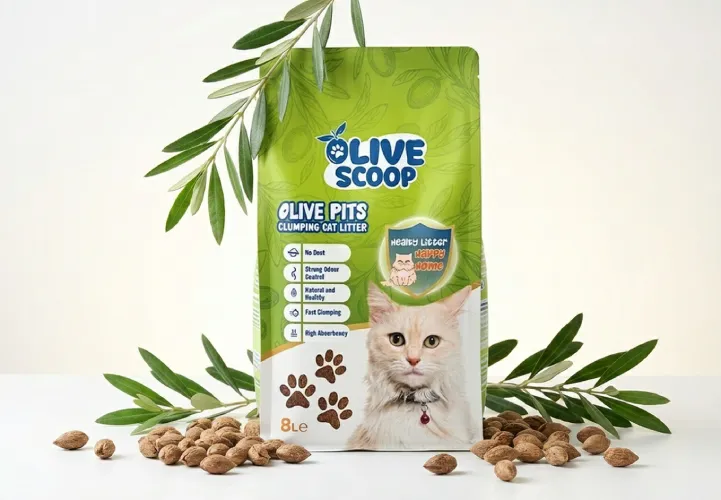
Putting those stones in the litter tray is the whole idea. They’re separated from the pressed fruit, washed, dried and milled into granules roughly the size of coarse sand. No mining, unlike clay. No trees felled, unlike wood pellet litter. No crop grown specifically to become litter, unlike tofu or corn types. The raw material already existed; it just needed a second job.
You’ll also see it called olive stone litter or olive litter. Same thing. The category is young: the first brands appeared in the United States around 2023, and OliveScoop brought the format to the UK with granules milled and packed at source in Turkey’s olive oil region.
The journey runs in six steps. Olives are pressed and the oil drawn off. The pits are then separated from the leftover pulp, washed clean of any fruit residue, and dried hard. Milling comes next, breaking the stones into consistent granules, followed by grading and de-dusting so what goes in the bag is uniform and clean. Then it’s bagged and shipped.
That’s it. For a 100% pits litter like OliveScoop, no coatings, gums or fragrances are added at any stage.
An olive stone is not solid the way a pebble is. Its shell is a dense, woody plant material shot through with microscopic pores, and milling exposes millions of those pores across every granule. When urine hits the litter, capillary action pulls the liquid into the granules, wet granules bind to their neighbours, and the patch sets into a firm lump you can lift out with a scoop.
The same porous structure is what holds smells in. The liquid, and the odour it carries, ends up locked inside the granule rather than sitting on the surface waiting for a breeze.
Honest answers, because a litter you end up hating helps nobody.
Clumping. Urine forms a solid, scoopable clump that lifts out in one piece. One practical tip: give fresh clumps a few minutes to firm up before you scoop. Reviewers testing olive litters have noted that clumps scooped immediately can shed crumbs at the edges, and patience solves it.
Odour. There’s no perfume here, which is deliberate. A cat’s sense of smell is many times more sensitive than ours, and heavily fragranced litters are a common reason cats reject a tray. Instead of masking smells, the granules absorb urine and hold it, so the smell leaves the room when the clump does.
Dust. This is the category’s headline. Pour a scoop of standard clay litter in a sunny room and you can watch the cloud hang in the air. Pour olive pit granules in the same light and there’s almost nothing to see. For households managing feline asthma, or humans who wince at every refill, that difference is the reason most people switch.
Weight and tracking. Olive granules are noticeably lighter than clay litre for litre, which your back appreciates on bin day. Some tracking happens with any granular litter; a mat by the tray catches most of it. And a minority of cats side-eye any texture change at all, which is why the switching method further down exists.
Read the ingredients line, because the category has quietly split into two recipes.
Some brands, mostly in the US, blend the pits with olive oil and guar gum. The gum glues clumps together faster and the oil is marketed as a paw conditioner. The trade-offs are documented: Cats.com’s hands-on review of the leading American olive litter, along with a run of customer feedback, reports oily residue transferring onto paws and floors, and a sticky paste forming at the base of some trays and self-cleaning machines.
The other recipe is just pits. OliveScoop is 100% milled olive stones with nothing added, so there’s no oil to track across your kitchen floor and no gum to turn to paste. The honest flipside: without an added gum doing the gluing, the clump sets as the granules themselves draw the moisture in, which is why that few-minutes-before-scooping tip matters.
Neither recipe is a scandal. But if you’ve read a complaint about “olive litter” being oily, it wasn’t about this kind.
One rule covers every clumping litter, this one included: very young kittens explore with their mouths, so hold off on clumping types until the eat-everything phase passes, commonly around 8 to 12 weeks. Before then, use a kitten-appropriate non-clumping option. Our guide to the safest cat litter for kittens covers the early weeks in detail.
Because the pits are a food-industry by-product with no added chemicals, a stray nibble is not the emergency it can be with some synthetic materials. Litter still isn’t food. If your cat repeatedly eats litter of any type, that’s a behaviour called pica and it deserves a conversation with your vet, because it sometimes signals an underlying issue.
No. Fresh from the bag there’s a faint, dry, woody scent, closer to a timber yard than a tapas bar, and it fades once the litter is in the tray. Nothing is added to make it smell of anything.
| Litter type | Clumps? | Dust | Weight | Everyday disposal |
|---|---|---|---|---|
| Clay (bentonite) | Yes, very firm | High | Heavy | General waste only |
| Silica crystals | No | Low to medium | Light | General waste only |
| Wood pellets | Mostly no; breaks to sawdust | Low, sawdust builds | Medium | General waste; some compost uses |
| Tofu | Yes | Low | Light | General waste; dislikes damp storage |
| Olive pit | Yes | zero | Light | General waste; compost with conditions |
Clay clumps hard and costs little upfront, but it’s strip-mined, heavy and dusty. Wood is cheap and natural but most pellet types dissolve into sawdust rather than clumping, a maintenance style not everyone loves; we’ve compared the two approaches in our pine pellet alternatives guide.
Tofu clumps well but can struggle in damp British homes if stored carelessly. Olive pit’s pitch is the combination: proper clumps, minimal dust, light bags, natural origin. For the wider field, start with our guide to natural alternatives to clay litter, and if you’re still weighing up clumping itself, clumping vs non-clumping settles that first question.
UK water companies advise against flushing any cat litter, including products sold as flushable, because litter contributes to sewer blockages and cat waste can carry parasites that treatment works aren’t designed to remove. So the routine is simple: scoop the clump, bag it, general waste bin.
Soiled litter should stay out of council food and garden waste collections too, since almost all councils exclude pet waste. Home composting is possible for the plant-based granules with a dedicated heap kept away from anything you’ll eat; our ethical disposal guide walks through the options properly.
Reseal the bag and keep it somewhere dry. Milled olive stone stores well, but no absorbent litter enjoys a leaky shed. A kitchen cupboard or dry utility shelf is ideal.
A single 8L bag of OliveScoop costs £20.99 at the time of writing, with multipacks bringing the per-litre price down. The per-month cost depends on how many cats you have and how you scoop: because it clumps, you only ever remove the used litter, so a bag stretches further than the same volume of anything you have to change wholesale. The cheapest way to learn your own household’s usage rate is the trial below.
Fill the tray to a depth of about 5 to 7 cm. Shallower than that and clumps weld themselves to the base; much deeper just wastes litter. Scoop clumps and solids once a day (twice in a multi-cat home), then top up with a handful of fresh granules to hold the depth. Because the soiled litter leaves with each scoop, a full empty-and-wash of the tray is only needed every few weeks rather than every few days.
Skip the deodorising powders while you’re at it. An unscented clumping litter is designed to remove smells rather than compete with them, and additives can put cats off the tray entirely; we’ve covered whether baking soda belongs in cat litter separately.
Cats are creatures of substrate habit, so change gradually. Days 1 and 2: one third olive pit mixed into two thirds of the old litter. Days 3 and 4: half and half. Days 5 to 7: two thirds new. Then go fully over.
Keep everything else about the tray identical during the switch, and if your cat hesitates at any stage, hold that ratio for a couple of extra days before moving on. Most cats never notice; the cautious ones just need the week.
It depends on your cat count and scooping habit, so any single number would be a guess. What changes the maths is clumping: you remove only what’s used and never bin clean litter, which is why an 8L bag outlasts 8L of any litter you change wholesale. Multi-cat homes get through it faster.
Usually not. Once litter is soiled it counts as pet waste, and nearly every UK council excludes pet waste from food and garden collections. Check your own council’s accepted list; unused clean spills can simply be swept into general waste.
Plenty of OliveScoop customers run it in self-cleaning machines. Firm clumps and minimal dust are exactly what rakes and sensors want, though it’s always worth checking your machine’s granule size guidance first.
Directly from OliveScoop, the UK’s olive pit litter brand, or on Amazon UK. First-time customers can claim a free bag and pay only £5 delivery, which is the lowest-risk way to find out what your cat makes of it.