
Most cat litter deodorisers don’t fix the smell. They cover it. You sprinkle a perfumed powder over the tray, the floral scent and the ammonia mingle, and within a day you’re back where you started – except now the room smells of “fresh linen” and cat wee at the same time.
So here’s the honest version, up front. The thing that actually controls litter tray odour isn’t something you add on top. It’s the litter you choose and how often you scoop. A genuinely odour-absorbing, dust-free litter plus a clean tray does the overwhelming majority of the work. A deodoriser, at its best, buys you a little extra time between scoops. At its worst, it puts your cat off the tray altogether and creates a different mess to clean up.
This guide covers what a cat litter deodoriser or “deodorizer”, if you’re typing the American spelling – really does, which types are worth bothering with, the truth about baking soda that most articles skip, the scented products that are genuinely unsafe for cats, and the simple routine that keeps a home smelling clean without drowning it in perfume.
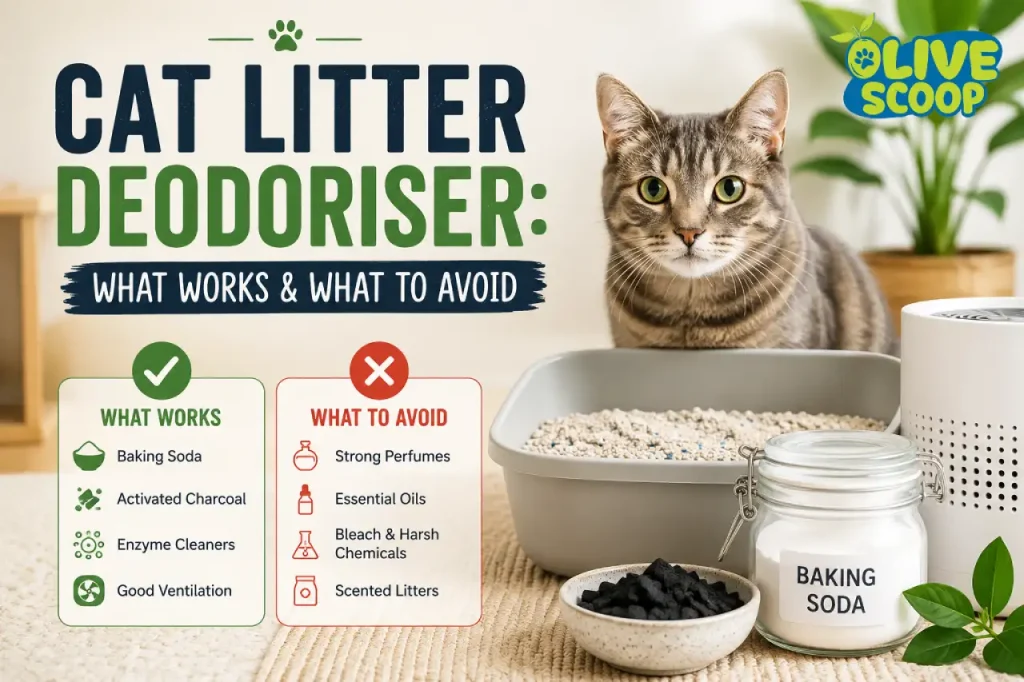
A cat litter deodoriser is anything you add to, or place near, the litter tray to cut the smell. That’s a broad church, and the products in it work in very different ways:
The important distinction isn’t the format. It’s whether a product masks a smell with a stronger one or neutralises the molecules causing it. Masking is the cheap, common approach, and it’s the one that tends to disappoint. Neutralising – or better still, stopping the smell forming in the first place – is what actually works. Keep that split in mind and most of the marketing on the shelf sorts itself out.
You can’t fix a smell you don’t understand, and this one is mostly down to a single gas: ammonia.
Fresh cat urine doesn’t smell of much. The trouble starts after it sits in the tray. Urine contains urea, and bacteria in the litter break that urea down into ammonia – the sharp, eye-watering note you get from a tray that’s overdue a scoop. The longer waste stays put and the warmer the room, the more ammonia builds up. That’s the whole reason an unscooped tray gets dramatically worse by day two or three rather than staying merely unpleasant.
There’s a second culprit, especially in homes with un-neutered or older toms. Cat urine contains a sulphur-based compound called felinine, which breaks down into smaller sulphurous molecules – the same family of chemistry that makes rotten eggs so memorable. It’s part of how cats scent-mark, and it’s stubborn.
This matters for one practical reason. A perfume sprayed over the top does nothing to the bacteria, the ammonia, or the sulphur compounds. It just adds a third smell to the two already there. Anything that genuinely helps has to either remove the waste, absorb the gas, or stop it forming – not paint over it.
Baking soda
Baking soda – sodium bicarbonate – is the internet’s favourite litter hack, and it’s worth understanding properly rather than taking on faith.
The theory is reasonable. Baking soda is alkaline, sitting around pH 8.4, while healthy cat urine is mildly acidic at roughly pH 6.3 to 6.6. Alkaline meets acidic, odours get neutralised – the same principle as the open box in your fridge. Learn Is Baking Soda in Cat Litter Safe?
The reality is messier, and it’s where most guides stop short. Raising the pH of the litter can actually speed up the conversion of urea into ammonia, because the bacteria responsible work faster in less acidic conditions. In other words, the thing you added to reduce the ammonia smell can, over a day or two, encourage more of it. Baking soda is also a very fine powder, so when your cat digs, it kicks up airborne dust – a genuine problem for cats with asthma or respiratory sensitivities, and for the humans cleaning the tray. And if you use a clumping litter, mixing baking soda through it can interfere with how firmly the clumps form, leaving you with a soggier scoop.
Is it dangerous? Not in the small amounts people use – a cat would have to eat a great deal of it to be poisoned, which is very unlikely from a dusting in the tray. The case against baking soda isn’t toxicity. It’s that it’s dusty, it can backfire on the ammonia front, and with a modern clumping litter that lifts the urine straight out, there’s far less for it to do in the first place. Save it for the fridge.
Powder and granule deodorisers
These are the high-street staples – Beaphar, Arm & Hammer, supermarket own-brands – typically baking soda plus a fragrance, sometimes with urine-encapsulation or “pro-bacteria” claims on the tub.
The encapsulation and odour-trapping versions are a step up from pure perfume, and some genuinely extend the time between full litter changes. But the fragranced ones carry the same two risks as baking soda: dust, and a scent strong enough to put a sensitive cat off the tray. Read the tub. “Neutralises” and “fragrance-free” are better signs than “spring breeze”.
Activated charcoal
Activated charcoal works by adsorption – odour molecules stick to its enormous internal surface area and are held there, rather than being covered with a competing smell. It’s fragrance-free, low-dust, and a sensible option for households that want odour control without perfume, whether sprinkled in lightly or kept in a sachet near the tray.
The honest limitation: charcoal helps, but it isn’t magic, and it doesn’t replace scooping. Think of it as a useful backstop, not a cure.
Sprays
Litter and tray sprays are mostly about masking, and they’re the shortest-lived option of the lot – you’re spraying a scent onto a surface a cat is about to dig through. Some bio-based or enzymatic sprays do break down odour compounds rather than cover them, which is better, but even those need reapplying constantly. For the litter itself, sprays are the weakest tool here. They’re more useful for cleaning the empty tray.
Hanging odour blockers
Products like Moodify hang above the tray and release a compound designed to cancel smells in the air rather than sit in the litter. The clever bit is that nothing changes underfoot, so you’re far less likely to put your cat off the tray – a real advantage for fussy cats. They can work surprisingly well for a single tray. The downside is ongoing cost, which adds up fast if you’ve several trays around the house.
Odour-control litter
This is the one most people overlook, and it’s the most effective of the lot – because the deodorising is built into the material your cat already uses, with nothing extra to add, no perfume, and no dust cloud.
Some litters lean on heavy fragrance to do this, which brings us straight back to the masking problem. Others control odour through the structure of the material itself. Olive-pit litter is a good example: the porous cellular structure of the processed stone absorbs liquid on contact and traps and neutralises ammonia at the source, so the smell has less chance to form in the first place. OliveScoop is made from 100% upcycled olive pits here in the UK, clumps fast and firmly, is fully biodegradable, and is genuinely dust-free – which is the point for any home where the smell and the dust are the problem. Get the litter right and the question of which deodoriser to buy often disappears.
Mostly, but not always – and the exceptions matter, because a cat’s sense of smell and its physiology are nothing like ours.
Essential oils are the big one. “Natural” on the label doesn’t mean safe for cats. Cats lack some of the liver enzymes needed to process certain plant compounds, so a number of essential oils are toxic to them – including tea tree (melaleuca), citrus, pine, eucalyptus, peppermint, cinnamon, wintergreen and ylang-ylang. Several popular litter fresheners are built around exactly these oils. If a deodoriser lists essential oils and doesn’t specify they’re formulated to be cat-safe, leave it on the shelf, and never add neat essential oil to a tray yourself.
Over-scenting backfires behaviourally. A cat’s nose is vastly more sensitive than yours, so a fragrance that reads as “fresh” to you can be overpowering to your cat. The common result is litter tray avoidance – the cat decides the perfumed tray is unpleasant and starts going elsewhere. A deodoriser that smells lovely to you but stops your cat using the tray has made the problem considerably worse.
Dust is the quiet risk. Fine powders – baking soda included – add airborne particles every time the cat digs. For a cat with feline asthma or any respiratory sensitivity, that’s a real concern, and it’s a good reason to favour low-dust or dust-free approaches across the board. Read Can Dusty Litter Cause Asthma in Cats?
The safest deodorising is the kind that doesn’t rely on fragrance at all: a clean tray, an odour-absorbing dust-free litter, and, if you want a backstop, fragrance-free activated charcoal.
If you do nothing else from this article, do these. This is the routine that works, deodoriser or not.
Scoop at least once a day – twice is better. This is the single biggest lever. Ammonia builds from waste sitting in the tray, so removing it promptly removes the smell at its source. With a firm-clumping litter, a daily scoop lifts the urine clumps out cleanly before they have a chance to gas off.
Change the litter fully and wash the tray weekly. Even with daily scooping, residue builds up. Empty the tray completely about once a week, wash it with warm water and a little unscented washing-up liquid, dry it, and refill. Skip bleach and strong disinfectants – the residual smell can deter your cat, and bleach plus ammonia is a combination to avoid entirely. A vinegar rinse is a gentler way to cut lingering odour from the plastic.
Have enough trays. The rule of thumb is one tray per cat, plus one spare. Too few trays in a multi-cat home concentrates the smell and the usage, and it’s a frequent cause of cats going outside the tray.
Mind the location and airflow. A tray crammed into a small, unventilated cupboard concentrates odour and humidity, and humidity speeds bacterial growth. A spot with some airflow, away from where the cat eats, keeps smells from settling.
Choose a litter that controls odour and doesn’t make dust. This is where most of the battle is won or lost. A litter that absorbs liquid fast, clumps firmly so waste lifts out cleanly, and neutralises ammonia rather than perfuming over it will keep a home fresher than any sprinkle-on product. Dust-free matters too – both for your cat’s lungs and your own. It’s exactly the brief OliveScoop’s olive-pit litter was built for, and it’s why the right litter so often makes a separate deodoriser unnecessary.
Get this routine right and the tray simply doesn’t develop the smell you’d otherwise be trying to mask.
One thing worth knowing, because it’s easy to miss. If your cat’s urine suddenly smells much stronger or noticeably different, if the ammonia is overwhelming no matter how often you scoop, or if your cat starts going outside the tray, that can be a sign of a health problem rather than a litter problem. Urinary tract infections, kidney disease and diabetes can all change the smell and frequency of urine.
So if a clean tray and a good litter still aren’t enough, it’s worth a vet visit rather than a stronger deodoriser. This article is general guidance, not veterinary advice – when something changes with your cat’s toileting, your vet is the right call.
You can, and it won’t poison your cat in the small amounts used. But it’s dusty, it can interfere with clumping, and by raising the litter’s pH it can actually encourage more ammonia over a day or two. With a good clumping litter that removes the urine when you scoop, there’s little reason to bother.
Powder deodorisers are usually designed to go on the bottom of a clean, empty tray first, with the litter added on top, then a light top-up between changes. Always follow the tub’s instructions – and use less than you think, both to limit dust and to avoid a scent strong enough to put your cat off.
A thin dusting, not a layer. More product means more dust and a stronger smell, which is exactly what deters cats. Sprinkle in fresh litter rather than every time you scoop, or you’ll end up with too much in the tray.
Powders can clog or interfere with the sieving mechanism in some self-cleaning boxes, so check the box’s guidance first. For automatic boxes, a low-dust clumping litter that controls odour on its own is usually the cleaner solution than adding powder.
Two common reasons. Either odour has soaked into a scratched plastic tray – in which case replace the tray – or the litter itself isn’t absorbing and neutralising well, so ammonia keeps forming between cleans. A non-porous tray and a better odour-control litter fix most lingering-smell complaints. If neither helps, rule out a health issue with your vet.
Not automatically, but heavy fragrance is a frequent cause of litter tray avoidance, and some scented products – especially those using essential oils like tea tree, citrus or pine – can be genuinely harmful. Fragrance-free is the safer default.
Daily scooping, a weekly full change, good airflow, and a naturally odour-absorbing, dust-free litter. If you want a fragrance-free backstop, activated charcoal adsorbs odour without masking it. No perfume required.
Cat litter deodorisers sit on a spectrum from “covers the smell for an afternoon” to “actively unsafe for your cat”, and the genuinely useful end of that spectrum is narrower than the shelf suggests. Baking soda is overrated and dusty. Sprays and heavy fragrances mostly mask. Activated charcoal is a decent fragrance-free helper. And the most effective deodorising of all isn’t a deodoriser – it’s a clean tray and a litter that absorbs liquid, clumps firmly, neutralises ammonia at the source, and doesn’t fill the air with dust.