
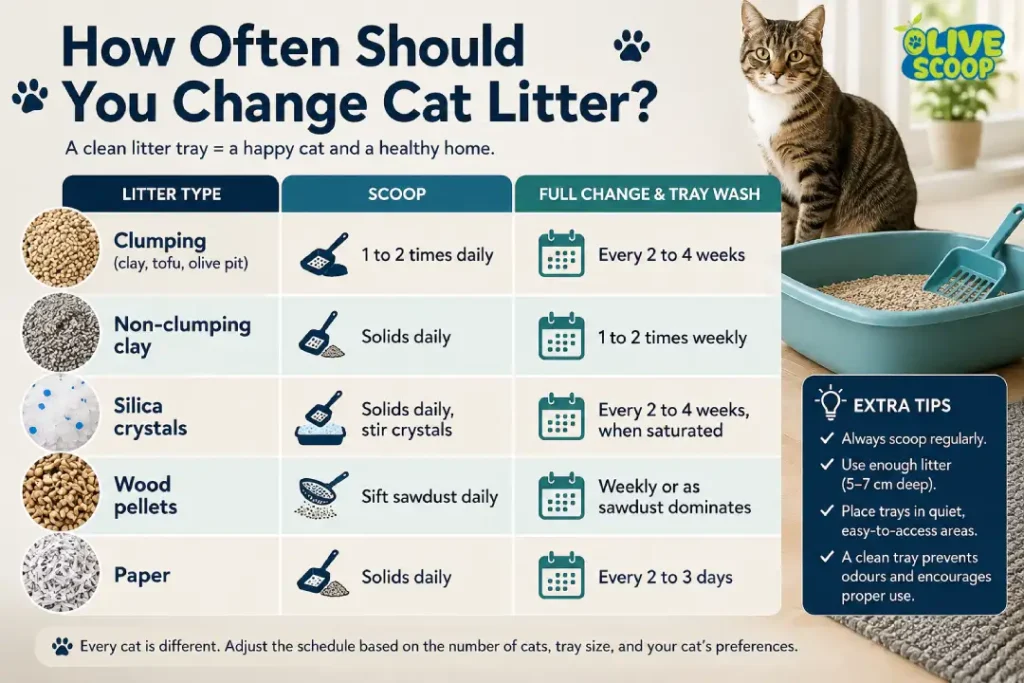
Scoop out clumps and faeces daily, and top up the litter level as needed. A full litter change and tray clean should be carried out according to how heavily the tray is used and its condition, rather than by the calendar: a well-scooped clumping tray in a single-cat home stays fresh for weeks, while a busy tray or a non-clumping litter reaches reset point far sooner.
Here’s how to judge it for your litter, your cat count and your nose.
| Litter type | Scoop | Full change and tray clean (judge by use and condition) |
|---|---|---|
| Clumping (clay, tofu, olive pit) | 1 to 2 times daily | When the base looks or smells tired; often weeks apart in a well-scooped single-cat tray |
| Non-clumping clay | Solids daily | Frequently; the whole bed holds urine, so condition slips within days |
| Silica crystals | Solids daily, stir crystals | When the crystals are saturated or discoloured |
| Wood pellets | Sift sawdust daily | When sawdust dominates the tray |
| Paper | Solids daily | Every few days; it saturates quickly |
Why do the types differ so much? Removal. Clumping litters let you lift out exactly what’s used, so the remaining litter stays genuinely clean and the full change becomes an occasional reset rather than a constant chore. Non-clumping types hold urine invisibly through the whole bed, so the only way to remove it is to remove everything. If you’re unsure which camp your litter falls into, our clumping vs non-clumping guide settles it.
Everything else flexes; this doesn’t. Cats are famously reluctant to use a soiled tray, and a skipped day of scooping is one of the fastest routes to a protest wee on the bath mat. Daily removal also stops urine sitting long enough to break down into ammonia, which is what actually makes a litter tray smell.
There’s a health angle too. Scooping daily means you notice changes early: more clumps than usual, smaller ones, straining, anything odd. Your scoop is the cheapest health monitor you own.
Two or more cats: everything accelerates. Scoop twice daily as standard and expect the tray to reach reset condition much sooner than a single-cat tray would. Each cat should have its own tray plus a spare, which spreads the load as well as the politics.
Kittens: scoop more often than feels necessary. Kittens are still forming tray habits, and a consistently clean tray is the strongest training aid there is.
Covered trays: the hood hides the state of the tray and concentrates the smell inside, exactly where your cat’s nose is. Lift the lid daily and err toward more frequent changes.
Summer: warmth speeds up odour chemistry, so tighten every interval when the weather’s hot.
Trust the tray, not the calendar. A full change is due when any of these appear: a smell that survives scooping; litter that looks discoloured or feels damp at the base; clumps that stick to the bottom rather than lifting free; your cat perching on the edge or scratching the tray sides instead of the litter; or paws being shaken off with theatrical disgust on exit. Cats communicate tray standards very clearly once you know the signals.
Empty everything into a bag for the bin. Wash the tray with warm water and a mild washing-up liquid, nothing strongly scented and no harsh disinfectants, because some cleaning chemicals are unsafe around cats and strong smells alone can put them off the tray; rinse well and dry. Refill to around 5 to 7 cm of fresh litter. The full routine, including what never to clean a tray with, is in our guide to cleaning a litter box.
One habit worth breaking: topping up forever without ever doing the reset. Fresh litter poured over a stale base just wraps the problem in a clean blanket.
Significantly. Because clumping litters only lose what’s actually used, a bag lasts far longer than the same volume of anything changed wholesale, and the tray between changes is genuinely cleaner rather than nominally cleaner. It’s why a pricier clumping bag often works out cheaper per month than the budget option it replaced. If you’re choosing between materials from scratch, our full guide to the <a href=”https://olivescoop.co.uk/blog/types-of-cat-litter/”>types of cat litter</a> compares all seven.
Can I just scoop and never fully change clumping litter?
No. Scooping removes most of the waste but fine soiled particles and dust accumulate at the base over time. A periodic reset keeps the whole bed fresh and lets you wash the tray itself, which absorbs odour over time, especially plastic trays. Let the tray’s condition and how heavily it’s used set the date, not the calendar; in a well-scooped single-cat home that point arrives slowly, in a busy multi-cat home much faster.
How often should you change litter for two cats sharing?
Ideally they shouldn’t share one tray at all; two cats need three trays. Where trays are shared, the tray works twice as hard, so scoop twice daily and expect it to reach full-change condition in a fraction of the usual time; judge it by smell and state, not the calendar.
Does cat litter expire?
Unused litter keeps more or less indefinitely if stored dry and sealed. Plant-based litters (wood, tofu, paper, olive pit) dislike damp storage, so reseal the bag and keep it out of leaky sheds.
How often should the tray itself be replaced?
Plastic trays scratch, and scratches hold odour and bacteria no wash fully removes. Once a tray smells even when clean, or the base is visibly scored, replace it; for most households that’s roughly once a year.